Showing posts with label istanbul university. Show all posts

Sunday, April 22, 2018

SERASKER GATE

Beyazıt, Fatih - İstanbul - Turkey

GPS : 41°00'39.6"N 28°57'51.1"E / 41.011000, 28.964194


PHOTOGRAPHS ALBUM

The most famous section of the main campus is the main entrance gate. This monumental door is not only the symbol of the Istanbul University, but also the symbol of “the concept of university” in Turkey. Entering the university also means entering this door with dreams.

Previously, there was a very different building on the current place of this main entrance gate. This initial gate that was constructed in 1827 was very similar to the huge gate of the Sublime Port (Bab-ı Ali) on its Soğukçeşme - Alay Pavillion side. While the Sublime Port (Bab-ı Ali) represented the power of the state in the Ottoman State, the Serasker Gate represented the military force.

The construction of the current gate was started in 1864. In the widening work that was started in Beyazıt Square in 1869, the new Serasker Gate and the pavilions on each side of the gate were used as the main elements of the square. This monumental gate is not only the symbol of the Istanbul University in Turkey but also the symbol of the "concept of university". Actually being a student is in the dreams to enter through this gate.

Today it is the main entrance to one of the oldest universities of the world; Istanbul University was established as a center for theological studies in Ottoman Empire period. Madrasah (School of theological and environmental sciences), was founded immediately after the conquest of Istanbul by Sultan Mehmed II, the conquerer, in 1453. The Madrasah is regarded as the precursor to the "Darülfünun". "Darülfünun" was founded as an institution of higher education on 23 July 1846 and it evolved into Istanbul University in 1923, after the Republic revolution.

The university building is the work of the French architect Bourgeois and there are controversies about the gates architect. Although some say it is the work of the same architect some believe that the plans of  Bekir Pasha, an engineer studying architecture in London were used. The gate is the witness of many student riots and political demonstrations of the Turkish political life.

The gate designed as a triumphal arch con-sists of two towers and an entrance area. It has the  arrangement of an entrance gate confined by low built towers on both sides, and a wide tripartite arch opening in the middle. The middle section of the entrance is designed for vehicles and the side sections are designed for pedestrians. The castle shaped towers are  designed  for guards. On the sections of the towers facing the square, there are two large clocks.

Nizamiye Gate, facing Beyazıt Square, gained a symbolic value with its curvilinear fringes on four sides and its curled, segmented dome. The exterior of the gate : The gate is registered  as "the District of Süleymaniye, Beyazıt Square No:1", and on top of its facade facing the Beyazıt Square, there is a marble stone displaying the letters TC. Below the oval marble stone, the phrase "Istanbul University" is written in bronze letters and the date MCDLIII is written in Roman numerals. Below the date is a tripartite design and a celî-sülüs inscription by Şefik Bey.

In the middle section of the inscription, there is "Daire-i Umur-i Askeriye", on the right is the first verse of Fetih Sura, and on the left is its third verse. This golden foiled inscription on a green background is signed by Şefik Bey. Below the verse on the left, there is the date 1282 (1865-66). The interior of the gate : On the oval medallion on the interior wall of the gate,  there is the emblem of Istanbul University featuring snakes. This emblem was designed by Ord. Prof. Dr. Süheyl Ünver.

Below the emblem is a sentence from Atatürk’s Address to Turkish Youth : "Turkish Youth! Your prime duty is to pre-serve and defend forever the Turkish independence and the Turkish  Republic. You will find the strength you need in your noble blood." - Gazi Mustafa Kemal

At the bottom there lies the inscription in 3 sections written by scribe Kazasker Mustafa İzzet Efendi with the following verses. The last line also carries the date 1282 (1865 - 66). Muttali’-i envar-ı şevket şems-i evc-i saltanat / Asuman durdukça olsun muzaffer nasr-ı aziz / Askere nüzhet kulu tebşir eder tarihini / Lütf-i şah Abdülaziz açtı der-i nasr-ı aziz. On the main  entrance gate adorned by ornamental writings and inscriptions, there are the signs of the most famous three calligraphers of the era.

The gate having traces of the neoclassically based empire style that began to be used at the beginning of the 19th century was constructed with an orientalist understanding that stands out also in other buildings at Beyazıt Square. Due to the developing relations with Europe and the personal attitude of Sultan Abdülaziz, the orientalist style was frequently used in  İstanbul in the 1860s. The resource of the orientalist style extends back t  Magrip.

Lacy network decorations on wide areas on the front, and segmented, pointed and horseshoe arches resemble the Alhambra Palace. With the modifications made in the 19th century,  Beyazıt Square became an important urban venue representing İstanbul. In the  unfinished project, the monumental gate of Istanbul University is located so as to overlook and rule Beyazıt Square.

LOCATION SATELLITE MAP


WEB SITE : Istanbul University Main Campus

MORE INFO & CONTACT
E-Mail : iubilgi@istanbul.edu.tr
Phone : +90 212 440 00 00

These scripts and photographs are registered under © Copyright 2018, respected writers and photographers from the internet. All Rights Reserved.

Tuesday, April 17, 2018

BAB-I SERASKERİ HOSPITAL

Gülhane, Fatih - Istanbul - Turkey

GPS : 41°00'38.5"N 28°58'41.2"E / 41.010694, 28.978111


PHOTOGRAPHS ALBUM

The building has been originally designed by Gasparo Trajano Fossati, and built between 1841 and 1843. The building was conceived to house the Hospital of the Ministry of War (Bab-ı Seraskeri Hastanesi).

Fossati was a Swiss-Italian architect who had designed the Russian Embassy in Pera/Beyoğlu, and who later conducted the works of restoration in Hagia Sophia. The central building of the university had been established two decades later, between 1867 and 1874, to house the Ministry of War and the General Command. In the last quarter of the nineteenth century,

Following the 1908 Constitutional Revolution, and particularly during the armistice years after the First World War, the building was used as a prison for political prisoners. Later, Fossati’s building was used as the headquarters of the Imperial Guard.

İSTANBUL UNIVERSITY, FACULTY OF POLITICAL SCIENCE

When, during the Republican Era, the building complex of the Ministry of War was transferred to Istanbul University, the Fossati Building was used as part of the Faculty of Medicine. The building was transferred to the Istanbul University Faculty of Political Science in the academic year 1980-1981.

The statue that is located at the entrance hall of the faculty has been designed in the 1980s by Ahad Hüseyni, a sculptor of Iranian origin. It consists of the figure of an old, lonely man holding a globe in the end. The globe symbolizes the difficulties and catastrophes that haunt the world. The face of the figure expresses hope from one side, and hopelessness from the other side.

LOCATION SATELLITE MAP


WEB SITE : Istanbul University Faculty of Political Science

MORE INFO & CONTACT
E-Mail : sbf@istanbul.edu.tr
Phone : +90 212 440 0000
Fax : +90 212 440 0203

These scripts and photographs are registered under © Copyright 2018, respected writers and photographers from the internet. All Rights Reserved.

Monday, May 1, 2017

BEYAZIT TOWER

Beyazıt, Fatih - Istanbul - Turkey

GPS : 41°00'45.7"N 28°57'53.1"E / 41.012692, 28.964749

Beyazit Tower / Fatih - Istanbul photo beyazid_tower101.jpg

PHOTOGRAPHS ALBUM

Beyazıt Tower is an 85 meter tall fire-watch tower located in the courtyard of Istanbul University's main campus on Beyazıt Square (known as the Forum Tauri in the Roman period) in Istanbul, Turkey, on top of one of the "seven hills" which Constantine the Great had built the city, following the model of Rome.

The first fire-watch tower in Beyazıt was built of timber in 1749, but it was burnt down during the 1756 Great Fire of Cibali. It was replaced by another timber tower on the same location, which was destroyed following the riots stirred by Sultan Mahmud II's decision to dissolve the Janissary Corps in 1826. The same year, another wooden tower was erected on the plot, designed and built by the palace architect Krikor Balyan, which was again set on fire by adherents of the Janissaries.

Beyazıt Tower was ordered by the Ottoman Sultan Mahmud II (1808-1839), and designed by Senekerim Balyan who built it of stone in 1828 on the place of the original wooden Beyazıt Tower which was destroyed in a fire and was constructed earlier by the architect's brother, Krikor Balyan.

The stone tower originally had a single floor of around 50 m2 at the top for fire watching, which was reached through a wooden staircase of 180 steps. This watch room has 13 round arched windows. Initially, the tower had a timber roof in the form of a cone. In 1849, three floors in octagonal plan with round windows were added on the top section: one for signaling, one for signal baskets and the last one for flags.

The smaller diameter of the highest three floors makes space for a terrace at the second floor. In 1889, an iron pole of 13 meters was erected on the roof. The tower was partly damaged by the earthquake of 1889 and was subsequently restored. At present, the tower has a stone roof and a wooden staircase of 256 steps.

Fire was an important threat for Istanbul and caused numerous wide scale disasters, largely because most houses in the Old City's historic quarters were made of timber. Beyazıt Tower, Galata Tower and İcadiye Fire Tower (on Vaniköy Hill) were used for spotting fire threats, as they commanded long distance views of the city from above.

The entire Old City (Yedikule, Topkapı, Kocamustafapaşa, Fatih, Beyazıt), the cross-section of the Golden Horn districts (Fener, Balat, Eminönü) and those of the Bosphorus (Tophane, Beşiktaş, Ortaköy), the entrance of the Sea of Marmara (Üsküdar, Kadıköy) and even the Princes' Islands towards the southeast of the city were within the range of watch sight from Beyazıt Tower.

Fire was signaled at daytime by lowering baskets and at night by lighting colored lamps. The number of the baskets or the number and the color of the lamps indicated the location, i.e. in which district of Istanbul the fire out broke. As a response, the Watch Tower of İcadiye on the Anatolian side of the Bosphorus then fired 7 volleys to inform the citizens of the fire. 20 fire fighters were stationed in the Beyazıt Tower until 1923. In 1997, the structure underwent a thorough restoration.

Beyazıt Tower is still in use today as a watch-tower as well as for signaling weather forecast and maritime navigation information to the ships on the Golden Horn at night. The tower lost its importance with the development of advanced communications technology. Recently, two fire fighters in three shifts are stationed in the tower for guarding purposes only. Since 1972, special permission is required to enter the tower.

LOCATION SATELLITE MAP


These scripts and photographs are registered under © Copyright 2017, respected writers and photographers from the internet. All Rights Reserved.

Sunday, April 23, 2017

SEYYİT HASAN PAŞA MADRASA

Beyazit, Fatih - Istanbul - Turkey

GPS : 41°00'37.0"N 28°57'41.2"E / 41.010278, 28.961444

 photo seyyithasan_medresesi125.jpg

PHOTOGRAPHS ALBUM

Slight slope on a plot of a madrasa greatest taken as well as stone, braided in two alternating rows of brick walls, the material has been built. Rectangular windows with pointed arches open to the outside facades of brick and cut stone pediments shoveled. The top two rows of brick building surrounded by spiked fringe. Gained ground floor west-facing front elevation, slope, covered with cut stone. Round-arched door opening from the axis has shifted to the right.

That the date 1158 on the door of the poet Nimet’e Seyyid Ahmed Hocazade marble inscription was written by nine coupleted suspend a line. Starting barrel-vaulted hallway stairs to the courtyard of the madrasa greatest reached. Arches on the gate opens onto the courtyard area and sitting in front of the two columns that have been evaluated as an iwan of the madrasa floor of this unit over other units is kept high, there is the mirror.

Wool to the front of the two original windows in the south west of the classroom, this unit / mosque venue is necessary to round arched door. There is an inscription in two lines on the door. The square shaped classroom / mosque above the transition squinches provided internally threaded, externally covered with an octagonal dome. Two windows in three directions, with the window open to the outside space of three fronts in the western direction of cut stone consoles were slightly forward.

Placed on the altar in the corner, tromplarda, the dome is stenciled decorations. Purity dome in the heart of Surat, Surat an-Nur base of the dome, the pendentives formed at the corners of squinches filled with God, Muhammed, the Four Caliphs, Hassan and Hussein are writing. Squinches filled with consoles that make up the elegant arches are filled six vegetative form. Although renovated, reflecting the transfer of works of art style of the pen. Classroom / mosque prayer times of the past are known to be open to the outside community.

Classroom / space is a small mosque minarets on either side close to the southern front corner and a bird in an elegant mansion, which was placed two steps out of consoles. Grooved on three sides except the south courtyard titled openings with pointed arches made of brick with marble columns, sits surrounded by porches. East and west direction, mirrored vault above the porticos, the north direction, provided the transition pendantives covered with domes.

Porticos behind the east, west and north direction has been ranked in the madrasa rooms. These rooms are covered with domes on pendentives northern and Eastern peoples. Two rooms at the west front of the mirror in front vault. Round-arched niches rooms with lockers and stove inside a rectangular aperture door and a window opens with a courtyard. Pointed arches, pediments over doors and windows, most of this is called the glass decorated underwear.

The rooms have windows opening outwards. And the Northeast corner of the rectangular unit, which is regulated as a latrine in northern and eastern direction with two square openings called windows and mirrors above the vault covered with elephant eyes. That are known to have a fountain in the courtyard now survive. In 1914, repaired in 1892 saw the madrasa, a fountain, laundry, the toilet and abdesthane needed repair, the inspection report of the delegation determined.

Undergoing a thorough repair in 1949 three windows that opened to the south of the courtyard building. Then again repaired in 1990 and now sees the structure of Istanbul University, Institute for Eurasian Studies, the activity continues.

ISTANBUL UNIVERSITY, INSTITUTE FOR EURASIAN STUDIES

Since the Eurasian region, which is closely related with the past history of our country, cultural, economic and political characteristics and potential of the study and carry out in this way the different relations of our country needs today can display information about the region and the production staff is the primary objective of our institute.

The region is extremely important historical and cultural ties, not only for our country, in the last twenty years as a result of dramatic transformations in the political-military exchanges and many new independent states, especially in today’s chaotic structure of its energy and natural gas resources, and also for the world balance of has a strategic importance.

The chaotic structure, history and diplomatic resources needed to solve the problems of the region born in the past, the region is active and decisive role played by inter-communal relations, especially in the Ottoman Archives presence in Turkey, today brings Turkey to have a say in the region. In particular, both geographically and politically active in Eurasia in a position the geographic area extending from Turkey and the Balkans and the Caucasus in the Middle East, starting from the date on which the state has a cultural and political ties.

For this reason, both experts familiar with the languages ​​of the Eurasian region and to provide for education and academic staff, graduate programs for this purpose and carry out open in the region, creating the infrastructure required to produce a solution to issues of interest to Turkey and to this end, and academic publications of our institute aims to organize activities.

The Institute is an interdisciplinary perspective to follow developments closely with the geography of the region, aims to further investigations and research. Black Sea, the Caucasus and the Middle East, Eastern Mediterranean and the Aegean, the Balkans and Eastern Europe, and finally the Central Asian countries such as the different geographies, political, historical, social and cultural aspects and problems of Turkey and links with and understanding of these problems is investigated in a sufficient manner perspectives is to produce solutions.

Thus in Turkey, especially in the academic field, doing research on this region and to provide guidance to researchers seeking to build knowledge in the formation of cadres and publications will be provided. In addition, the Institute for Eurasian region, including national and international congresses, conferences, colloquia, symposia, panel discussions, seminars, talks, courses, exhibitions, scientific meetings and publication activities, such as memorial days alone, as the performing or contribute to the achievement in bilateral and multilateral targeted the development of mutual knowledge and opinion are consulted.

LOCATION SATELLITE MAP


WEB SITE : Istanbul University, Institute for Eurasian Studies

MORE INFO & CONTACT
E-Mail : avrasya@istanbul.edu.tr
Phone : +90 212 455 5859 / +90 212 455 5700
Fax : +90 212 455 5762

These scripts and photographs are registered under © Copyright 2017, respected writers and photographers from the internet. All Rights Reserved.

Sunday, January 8, 2017

ATATÜRK ARBORETUM

Bahçeköy, Sarıyer - İstanbul - Turkey

GPS : 41°10'35.0"N 28°59'06.0"E / 41.176389, 28.985000
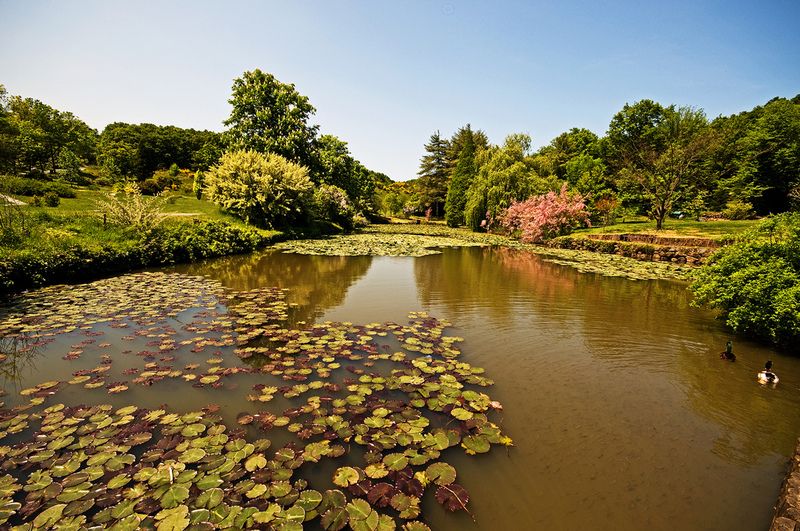
Ataturk Arberetumu / Bahcekoy, Sariyer - Istanbul photo ataturk_arboretum104.jpg

PHOTOGRAPHS ALBUM

Here’s one of the city’s best-kept secrets, a 296-hectare botanical garden accessed from the road linking Bahçeköy in the Belgrade Forest to Kemerburgaz. With a sizeable lake and more than 2,000 species of plant - all beautifully labeled, this is a great place to escape the stresses of city life while learning something at the same time. One snag - it’s only open to the public on weekdays.

Atatürk Arboretum is basically a botanical garden containing living collections of primarily woody plants of Turkey and world intended for education-training and scientific studies. This first arboretum of Turkey was founded in 1949 with the scientific and technical consultation of the faculty with the support of Bahçekoy Enterprise of Forest Service.

It was named after Atatürk in the 100th birthday of the founder of Turkish Republic. The arboretum has become a forestry enterprise in the same year. Around 2000 plant taxa can be seen in this 296 hectares botanical garden. It is open to public throughout the week, free in the weekdays and with a fee in the weekends.

This first arboretum of Turkey was founded in 1949 with the scientific and technical consultation of the faculty with the support of Bahçeköy Enterprise of Forest Service next to the Büyükdere - Bahçeköy - Kemerburgaz road in an area of 38 ha. Later on Monsieur Guinet, one of the inspectors of Sorbonne University Botanical Garden, was invited to Istanbul for the accomplishment of arboretum project. His studies continued intermittently between 1959-1961 until he planned the circulation system.

However project set up mired down, while indispensable financial support could not be provided and what is left behind Guinet was the plan of plant regions of the world separated by the circulation. In addition, he also prepared the lists of the plants that should take place in these plant regions. Infrastructure and plantation works continued, even though its slow tempo, until 1982. In the same year it was named after Ataturk because of the 100th birthday of the founder of the Turkish Republic.

Atatürk Arboretum is open to public throughout the week, however only who has a free entrance card shall enter at the weekends and on official holidays. Free entrance card is offered for sale yearly and it is valid for the whole family. It should be renewed every year. Please fill the application form for the entrance card. School, club, company and association visits are due to fee and a rendezvous should be taken before by calling. Information is given to groups by the beginning of the tour about arboretum and the plants.

One park in İstanbul has an example of almost every kind of the world’s many trees, and the Atatürk Arboretum, located in the city’s Belgrade Forest, is a wonderful place to visit during any season of the year. If you happen to visit the arboretum right after it has rained but when the sun is finally shining through the wet leaves, you won’t believe the beauty of the little lake surrounded by many different kinds of leaves. It looks like a postcard, but isn’t; it is a museum of trees, the perfect escape from the stresses of life and the city.

The entrance to the park has a sign that reads “You are currently in a museum of living plants and trees. This is not a simple park, but instead a collection of living plants and trees.” The first living creatures to greet us, however, were some friendly and good-natured dogs. The trees, more than anything else, make this park very different from the rest of the forest that surrounds it. A stroll around the little lake here is a stroll through trees that came all the way from North America, China, Japan, the former Yugoslavia, Mexico, and so on. This is truly an arboretum.

The Atatürk Arboretum hosts more than 2,000 trees on its grounds and is located on the road that connects Bahçeköy and Kemerburgaz. The spot was originally established by scientist Hayrettin Kayacık in 1949, and throughout the subsequent 60 years or so, people working for this living tree museum have fostered connections with other arboretums throughout the world to ensure that the Atatürk Arboretum now hosts all sorts of plants and trees that are not normally found in Turkey.

While many of the trees here have managed to adapt to the micro-climate provided by the Bahçeköy area, there are, of course, some which have not, and which remain stunted. Some of the most prized trees in this park are the American tulip tree, the Spanish fir tree, the American and Mexican oak trees, and the red-leaved Judas trees.

Touring around this park only takes about 90 minutes, and you will notice the many different kinds of birds that this variety of trees hosts. You will also notice that you are almost never alone in this garden: There are ducks, dogs and birds all around. And if you are really lucky, you might even see one of the roe deer that may stray through the premises. Picnics not allowed, but you can tour the park for free on weekdays

The arboretum does not allow picnicking on its grounds, but admission is free. Definitely intended for those with scientific interests, all the trees here bear signs noting where they came from and what they are named. All of this is to say, if you have a truly scientific interest in trees and plants, you might well find yourself spending up to three or four hours here on any given day. Interestingly, there really aren’t many people who visit this park - mostly groups of students, despite the fact that you can visit for free on weekdays.

When you visit the park as a group, a reservation must be made in advance. On weekends, only members can enter the park. Those interested in becoming members can apply for membership with management. The head of the arboretum, Mehmet Alan, notes that they treat visitors very seriously, as breaking even one leaf off a branch is forbidden here. There are paths all over the park, which is spread over 259 hectares of land, although visitors to the arboretum, who are given a special map to the land, are only allowed to tour 56 of these hectares.

Alright, but what are the best times to visit the Atatürk Arboretum? Alan says it’s “of course, during fall afternoons.” And truly, the sight of the many colors, particularly as they shine on the leaves in the wake of autumnal rainfall here, is one worth seeing. The land is also spectacularly gorgeous after snowfall. There is one section of this park that attracts an enormous amount of attention, and that is the oak parcel - a full 2,5 hectares devoted solely to the oak tree.

Here, there are 100 kinds of oak, from all over the world. Of course, there are also 1,600 kinds of exotic plants as well as a tree found in Chinese graveyards, and a Chinese scythe tree, not to mention a mammoth tree from the United States, the Asian sweet gum, the Japanese hydrangea, the Arizona cypress and many others. In fact, you can really say that this state-connected arboretum is really one of the few spots in İstanbul that reveals all of the beauty of the fall in all of its glory these days.

This park is open from morning until evening for anyone who is curious about trees, living museums and nature in general. All the keepers of this park ask is that when you do go, if you do go, to treat the plants and trees here with the respect and care they deserve.

There is also a wooden observation tower on one of the hilltops, offering a view of the surrounding forests and a spectacular sight of Bosphorus which is seen like a turquoise lake from that point. That same tower can also be used for birdwatching during autumn, as these hills are on one of the major routes of migratory birds on their way from Europe to Africa. During weekdays arboretum is open to public, however weekends are exclusively for members. Remember, no eating, no picnicking, and no smoking.

What separates an arboretum from an everyday forest is that it is established for science and research, with all specimens meticulously labeled. "If you don't label, you can collect as many species as you'd like; it just amounts to a nice collection or a pretty little park.

The arboretum is a public institution administered by the Ministry of Environment and Forestry's Istanbul Regional Forest Directorate but it also works with Istanbul University's forestry department for research. University students are tested here, a few NGOs have worked on projects and there are even talks of establishing a gene bank. But currently the research is lagging due to a lack of personnel.

But the arboretum is not all about research; it is also open to visitors. But it is not intended for the traditional park visitor. "The Belgrade Forest is a recreational park and it gets very crowded. The forest is under a lot of strain from misuse.".

Visitors cannot remove so much as a seed, leaf or branch. People cannot picnic, drink, play ball or even walk their dog. Nor are there any tours, but just peaceful pathways winding through trees. If you enjoy nature, if you are interested in flowers and plants, if you would like to read your book in an environment where nobody is picnicking, or just rest, the arboretum is ideal for you.

Herbarium (36 000 specimens)

Special Collections

Ginkgo biloba, Araucaria araucana, Abies (8 taxa), Pseudotsuga taxifolia, Picea (4 taxa), Cedrus atlantica, Pinus (18 taxa), Calocedrus decurrens, Chamaecyparis lawsoniana (3 taxa), Cupressocyparis leylandii (2 taxa), Cupressus (3 taxa), Juniperus (6 taxa), Cryptomeria japonica, Sequoia sempervirens, Sequoidendron giganteum, Taxodium distichum, Salix (3 taxa), Populus tremula, P. nigra, Crataegus monogyna, Juglans nigra, Pterocarya fraxinifolia, Betula (6 taxa), Alnus glutinosa, Carpinus betulus, Corylus colurna, C. maxima var. purpurea, Ostrya carpinifolia, Nothofagus procera, Fagus sylvatica, Quercus (6 taxa), Ulmus (2 taxa), Clematis montana, Mahonia pinnata, Berberis thunbergii, Cercidiphyllum japonicum, Magnolia grandiflora, M. soulangeana, Liriodendron tulipifera, Laurus nobilis, Liquidambar styraciflua, L. orientalis, Cotoneaster dammeri, Prunus cerasifera, Pyrancantha coccinea, Sorbus aucuparia, S. terminalis, Albizzia julibrissin, Cercis siliquastrum, Robinia hispida, Sophora japonica, Buxus sempervirens, Ilex crenata, Aucuba japonica, Acer (10 taxa), Aesculus X carnea, A. hippocastanum, Camellia japonica, Eleagnus pungens, Hippophae rhamnoides, Rhododendron luteum, Forsythia viridissima, Fraxinus excelsior, Syringa vulgaris, Nerium oleander Viburnum orientale, Erica, Calluna, Arbutus unedo, Cornus australis, Phillyrea latifolia, Ligustrum vulgare, Sarcopoterium spinosum, Genista tinctoria, Spartium junceum, Daphne pontica, and more than 400 herbaceous taxa

LOCATION SATELLITE MAP


WEB SITE : Atatürk Arboretum

MORE INFO & CONTACT
E-Mail : orman@istanbul.edu.tr
Phone : +90 212 338 2400
Fax : +90 212 338 2424

These scripts and photographs are registered under © Copyright 2017, respected writers and photographers from the internet. All Rights Reserved.