Bahçeköy, Sarıyer - İstanbul - Turkey
GPS : 41°10'35.0"N 28°59'06.0"E / 41.176389, 28.985000
 PHOTOGRAPHS ALBUM
Here’s one of the city’s best-kept secrets, a 296-hectare botanical garden accessed from the road linking Bahçeköy in the Belgrade Forest to Kemerburgaz. With a sizeable lake and more than 2,000 species of plant - all beautifully labeled, this is a great place to escape the stresses of city life while learning something at the same time. One snag - it’s only open to the public on weekdays.
Atatürk Arboretum is basically a botanical garden containing living collections of primarily woody plants of Turkey and world intended for education-training and scientific studies. This first arboretum of Turkey was founded in 1949 with the scientific and technical consultation of the faculty with the support of Bahçekoy Enterprise of Forest Service.
It was named after Atatürk in the 100th birthday of the founder of Turkish Republic. The arboretum has become a forestry enterprise in the same year. Around 2000 plant taxa can be seen in this 296 hectares botanical garden. It is open to public throughout the week, free in the weekdays and with a fee in the weekends.
This first arboretum of Turkey was founded in 1949 with the scientific and technical consultation of the faculty with the support of Bahçeköy Enterprise of Forest Service next to the Büyükdere - Bahçeköy - Kemerburgaz road in an area of 38 ha. Later on Monsieur Guinet, one of the inspectors of Sorbonne University Botanical Garden, was invited to Istanbul for the accomplishment of arboretum project. His studies continued intermittently between 1959-1961 until he planned the circulation system.
However project set up mired down, while indispensable financial support could not be provided and what is left behind Guinet was the plan of plant regions of the world separated by the circulation. In addition, he also prepared the lists of the plants that should take place in these plant regions. Infrastructure and plantation works continued, even though its slow tempo, until 1982. In the same year it was named after Ataturk because of the 100th birthday of the founder of the Turkish Republic.
Atatürk Arboretum is open to public throughout the week, however only who has a free entrance card shall enter at the weekends and on official holidays. Free entrance card is offered for sale yearly and it is valid for the whole family. It should be renewed every year. Please fill the application form for the entrance card. School, club, company and association visits are due to fee and a rendezvous should be taken before by calling. Information is given to groups by the beginning of the tour about arboretum and the plants.
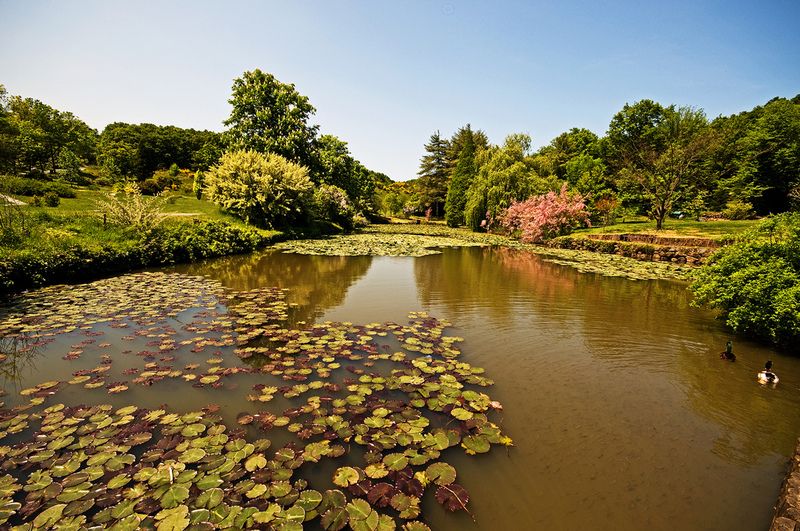
One park in İstanbul has an example of almost every kind of the world’s many trees, and the Atatürk Arboretum, located in the city’s Belgrade Forest, is a wonderful place to visit during any season of the year. If you happen to visit the arboretum right after it has rained but when the sun is finally shining through the wet leaves, you won’t believe the beauty of the little lake surrounded by many different kinds of leaves. It looks like a postcard, but isn’t; it is a museum of trees, the perfect escape from the stresses of life and the city.
The entrance to the park has a sign that reads “You are currently in a museum of living plants and trees. This is not a simple park, but instead a collection of living plants and trees.” The first living creatures to greet us, however, were some friendly and good-natured dogs. The trees, more than anything else, make this park very different from the rest of the forest that surrounds it. A stroll around the little lake here is a stroll through trees that came all the way from North America, China, Japan, the former Yugoslavia, Mexico, and so on. This is truly an arboretum.
The Atatürk Arboretum hosts more than 2,000 trees on its grounds and is located on the road that connects Bahçeköy and Kemerburgaz. The spot was originally established by scientist Hayrettin Kayacık in 1949, and throughout the subsequent 60 years or so, people working for this living tree museum have fostered connections with other arboretums throughout the world to ensure that the Atatürk Arboretum now hosts all sorts of plants and trees that are not normally found in Turkey.
While many of the trees here have managed to adapt to the micro-climate provided by the Bahçeköy area, there are, of course, some which have not, and which remain stunted. Some of the most prized trees in this park are the American tulip tree, the Spanish fir tree, the American and Mexican oak trees, and the red-leaved Judas trees.
Touring around this park only takes about 90 minutes, and you will notice the many different kinds of birds that this variety of trees hosts. You will also notice that you are almost never alone in this garden: There are ducks, dogs and birds all around. And if you are really lucky, you might even see one of the roe deer that may stray through the premises. Picnics not allowed, but you can tour the park for free on weekdays
The arboretum does not allow picnicking on its grounds, but admission is free. Definitely intended for those with scientific interests, all the trees here bear signs noting where they came from and what they are named. All of this is to say, if you have a truly scientific interest in trees and plants, you might well find yourself spending up to three or four hours here on any given day. Interestingly, there really aren’t many people who visit this park - mostly groups of students, despite the fact that you can visit for free on weekdays.
When you visit the park as a group, a reservation must be made in advance. On weekends, only members can enter the park. Those interested in becoming members can apply for membership with management. The head of the arboretum, Mehmet Alan, notes that they treat visitors very seriously, as breaking even one leaf off a branch is forbidden here. There are paths all over the park, which is spread over 259 hectares of land, although visitors to the arboretum, who are given a special map to the land, are only allowed to tour 56 of these hectares.
Alright, but what are the best times to visit the Atatürk Arboretum? Alan says it’s “of course, during fall afternoons.” And truly, the sight of the many colors, particularly as they shine on the leaves in the wake of autumnal rainfall here, is one worth seeing. The land is also spectacularly gorgeous after snowfall. There is one section of this park that attracts an enormous amount of attention, and that is the oak parcel - a full 2,5 hectares devoted solely to the oak tree.
Here, there are 100 kinds of oak, from all over the world. Of course, there are also 1,600 kinds of exotic plants as well as a tree found in Chinese graveyards, and a Chinese scythe tree, not to mention a mammoth tree from the United States, the Asian sweet gum, the Japanese hydrangea, the Arizona cypress and many others. In fact, you can really say that this state-connected arboretum is really one of the few spots in İstanbul that reveals all of the beauty of the fall in all of its glory these days.
This park is open from morning until evening for anyone who is curious about trees, living museums and nature in general. All the keepers of this park ask is that when you do go, if you do go, to treat the plants and trees here with the respect and care they deserve.
There is also a wooden observation tower on one of the hilltops, offering a view of the surrounding forests and a spectacular sight of Bosphorus which is seen like a turquoise lake from that point. That same tower can also be used for birdwatching during autumn, as these hills are on one of the major routes of migratory birds on their way from Europe to Africa. During weekdays arboretum is open to public, however weekends are exclusively for members. Remember, no eating, no picnicking, and no smoking.
What separates an arboretum from an everyday forest is that it is established for science and research, with all specimens meticulously labeled. "If you don't label, you can collect as many species as you'd like; it just amounts to a nice collection or a pretty little park.
The arboretum is a public institution administered by the Ministry of Environment and Forestry's Istanbul Regional Forest Directorate but it also works with Istanbul University's forestry department for research. University students are tested here, a few NGOs have worked on projects and there are even talks of establishing a gene bank. But currently the research is lagging due to a lack of personnel.
But the arboretum is not all about research; it is also open to visitors. But it is not intended for the traditional park visitor. "The Belgrade Forest is a recreational park and it gets very crowded. The forest is under a lot of strain from misuse.".
Visitors cannot remove so much as a seed, leaf or branch. People cannot picnic, drink, play ball or even walk their dog. Nor are there any tours, but just peaceful pathways winding through trees. If you enjoy nature, if you are interested in flowers and plants, if you would like to read your book in an environment where nobody is picnicking, or just rest, the arboretum is ideal for you.
Herbarium (36 000 specimens)
Special Collections
Ginkgo biloba, Araucaria araucana, Abies (8 taxa), Pseudotsuga taxifolia, Picea (4 taxa), Cedrus atlantica, Pinus (18 taxa), Calocedrus decurrens, Chamaecyparis lawsoniana (3 taxa), Cupressocyparis leylandii (2 taxa), Cupressus (3 taxa), Juniperus (6 taxa), Cryptomeria japonica, Sequoia sempervirens, Sequoidendron giganteum, Taxodium distichum, Salix (3 taxa), Populus tremula, P. nigra, Crataegus monogyna, Juglans nigra, Pterocarya fraxinifolia, Betula (6 taxa), Alnus glutinosa, Carpinus betulus, Corylus colurna, C. maxima var. purpurea, Ostrya carpinifolia, Nothofagus procera, Fagus sylvatica, Quercus (6 taxa), Ulmus (2 taxa), Clematis montana, Mahonia pinnata, Berberis thunbergii, Cercidiphyllum japonicum, Magnolia grandiflora, M. soulangeana, Liriodendron tulipifera, Laurus nobilis, Liquidambar styraciflua, L. orientalis, Cotoneaster dammeri, Prunus cerasifera, Pyrancantha coccinea, Sorbus aucuparia, S. terminalis, Albizzia julibrissin, Cercis siliquastrum, Robinia hispida, Sophora japonica, Buxus sempervirens, Ilex crenata, Aucuba japonica, Acer (10 taxa), Aesculus X carnea, A. hippocastanum, Camellia japonica, Eleagnus pungens, Hippophae rhamnoides, Rhododendron luteum, Forsythia viridissima, Fraxinus excelsior, Syringa vulgaris, Nerium oleander Viburnum orientale, Erica, Calluna, Arbutus unedo, Cornus australis, Phillyrea latifolia, Ligustrum vulgare, Sarcopoterium spinosum, Genista tinctoria, Spartium junceum, Daphne pontica, and more than 400 herbaceous taxa
LOCATION SATELLITE MAP
WEB SITE :
Atatürk Arboretum
MORE INFO & CONTACT
E-Mail :
orman@istanbul.edu.tr
Phone : +90 212 338 2400
Fax : +90 212 338 2424
These scripts and photographs are registered under © Copyright 2017, respected writers and photographers from the internet. All Rights Reserved.


