Sultanahmet, Fatih - İstanbul - Turkey
GPS : 41°00'30.0"N 28°58'32.0"E / 41.008333, 28.975556
The Historical Sultanahmet Hamamı was built in the 17 th century as a hamam. The hamam is tastefully renovated without changing the architectural specialities. Each top of the hamam was built in a different style.
Our services include : Washing, peeling, soup massage, locked clothes changing cabin, towel (peştemal), slippers (takunya)
Our hamam has two sections. First section is for the families both ladies and men where they can get inside and enjoy our hamam. The second one is only for the ladies. Our masseurs (tellaks) are, trined and proffesional people. We have male and female masseurs.
LOCATION SATELLITE MAP
WEB SITE : Sultanahmet Hamamı
MORE INFO & CONTACT
E-mail : info@sultanahmethamami.com
Phone : +90 212 513 7204
These scripts and photographs are registered under © Copyright 2017, respected writers and photographers from the internet. All Rights Reserved.
Showing posts with label pestemal. Show all posts
Showing posts with label pestemal. Show all posts
Wednesday, May 17, 2017

Monday, May 8, 2017
ÜSKÜDAR ÇİNİLİ HAMAM since 1640
Bağlarbası, Üsküdar - İstanbul - Turkey
GPS : 41°01'11.2"N 29°01'41.8"E / 41.019778, 29.028278
PHOTOGRAPHS ALBUM
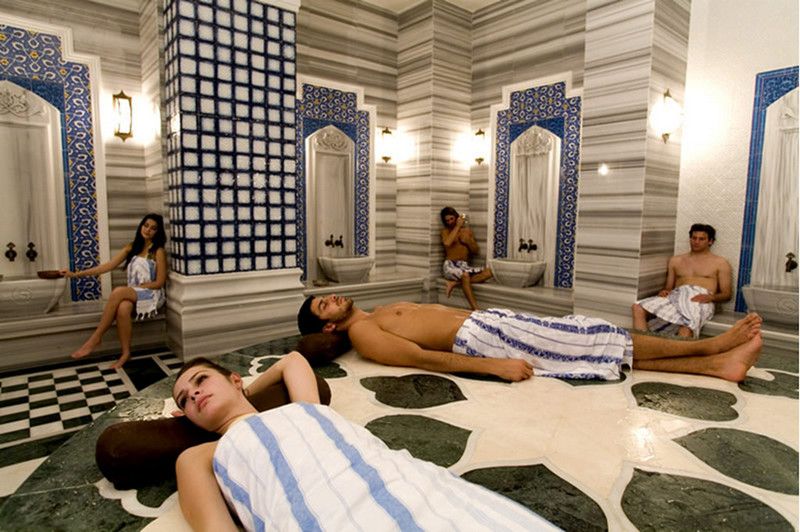
The Çinili Hamam was built in 1640 as part of a mosque complex ordered by the Valide Sultan Mahpeyker Kösem, wife of Sultan Ahmet I (r. 1604-1617) and mother of Sultan Ibrahim I. It was built as Çinili Mosque, library, police office and hamam. Çinili hamam was made for Çinili Mosque’s construction workers. The tiles had been stolen by the burglars. But Hamam’s owners were sticked to its original concept as using blue tiles. Hamam has still its own charm.
Mahpeyker Kösem Sultan was one of the most powerful women of the Ottoman 17th century and gained unprecedented influence in political decision-making when acting as regent, which she did three times, for her son Sultan Murad IV, and her grandson Sultan Mehmed IV. She made enemies as well as allies and was murdered in 1651 at the age of around 70.
Çinili Hamam has a natural heating system. It’ s heated by a boiler in the middle of two domes using woods for heating. It s using approxiamately 1 tons per months in winter and vapour throwing away by the aim of chimneys called "tüfeklik". Çinili Hamam has many differences seperated from the others with its 370 domes. The holes at the bottom of the dome provides sun light getting into the Hamam. In hot days; the lanterns is demounted and provided air to get into the intern area.
Her complex has been divided by modern roads; the baths stand at the junction of Çavuşere Caddesi and Çinili Hamam Sokağı. Taxi drivers may better understand Bağlarbaşı. It’s a 5 minutes drive from the Üsküdar Iskelesi.
This is a double bath, with separate sections for men and women. There are separate sections for men and women and a fountain at the entrance. Each has two central domed areas, one for the central room and the other acting as a large vestibule for relaxing. The name Çinili (tiled) apparently comes from the quantitities of Iznik tile that decorate both the mosque and the men’s bath, though I have seen neither.
The vestibule has been extensively remade to include small changing rooms on two levels. These have their own charm, but any sense of a gracious space under the dome has been lost along with any original tile - an effect not greatly helped by a quanitity of new, bathroom looking tile, cheap plastic patio furniture, and a space heater. The last is an unfair complaint on a cold day; like most 17th century buildings, this isn’t equipped with central heating.
Around the main domed room are a series of small alcoves alternating with small chambers. These house the faucets and basins which bathers themselves control. These are elegant marble, possibly 17th century, and the rooms are high ceilinged with niches for one’s peştemels (special hamam towels) and other bathing equipment. One of these small chambers is now a sauna; it’s bare-bones but hot and the wood is fragrant. The hamam is very clean and provides plastic flipflops.
There is a usual array of bathing attire. There is a kese (scrub) and soap and massage service, which is administered by one of several employees. The habits of the bathers range from social to serious; some are there to take care of their nails and hair as well as their skin. Clipping and filing is a public activity, but shaving goes on as quietly as possible, usually in a corner. Having a complete wash, which means nudity, also was done discretely, and a clean peştemel or bathrobe donned afterward.
On arrival, guests are guided into their own lockable changing room and given a pestemal, slippers and individual soap.They are then led to the main area which has a large marble slab in the middle and small rooms off to the side with small basins. There is also a sauna available for guests' use.
SERVICES
Bubble Massage
Stroke(Kese)
Oil Massage for Women
Open each day of the week.The opening days are also including offical holidays and festivals. In case you are more than 20 people ,we are able to help you for discount.
In case you are more than 20 people ,we are able to help you for discount.
Timetable
For Men : 07:00 - 22:00
For Women : 08:00 - 19:30
LOCATION SATELLITE MAP
WEB SITE : Çinili Hamam
MORE INFO & CONTACT
E-Mail : info@fcinilihamam.com
Phone : +90 216 553 1593 / +90 216 334 9710
These scripts and photographs are registered under © Copyright 2017, respected writers and photographers from the internet. All Rights Reserved.
GPS : 41°01'11.2"N 29°01'41.8"E / 41.019778, 29.028278

PHOTOGRAPHS ALBUM
The Çinili Hamam was built in 1640 as part of a mosque complex ordered by the Valide Sultan Mahpeyker Kösem, wife of Sultan Ahmet I (r. 1604-1617) and mother of Sultan Ibrahim I. It was built as Çinili Mosque, library, police office and hamam. Çinili hamam was made for Çinili Mosque’s construction workers. The tiles had been stolen by the burglars. But Hamam’s owners were sticked to its original concept as using blue tiles. Hamam has still its own charm.
Mahpeyker Kösem Sultan was one of the most powerful women of the Ottoman 17th century and gained unprecedented influence in political decision-making when acting as regent, which she did three times, for her son Sultan Murad IV, and her grandson Sultan Mehmed IV. She made enemies as well as allies and was murdered in 1651 at the age of around 70.
Çinili Hamam has a natural heating system. It’ s heated by a boiler in the middle of two domes using woods for heating. It s using approxiamately 1 tons per months in winter and vapour throwing away by the aim of chimneys called "tüfeklik". Çinili Hamam has many differences seperated from the others with its 370 domes. The holes at the bottom of the dome provides sun light getting into the Hamam. In hot days; the lanterns is demounted and provided air to get into the intern area.
Her complex has been divided by modern roads; the baths stand at the junction of Çavuşere Caddesi and Çinili Hamam Sokağı. Taxi drivers may better understand Bağlarbaşı. It’s a 5 minutes drive from the Üsküdar Iskelesi.
This is a double bath, with separate sections for men and women. There are separate sections for men and women and a fountain at the entrance. Each has two central domed areas, one for the central room and the other acting as a large vestibule for relaxing. The name Çinili (tiled) apparently comes from the quantitities of Iznik tile that decorate both the mosque and the men’s bath, though I have seen neither.
The vestibule has been extensively remade to include small changing rooms on two levels. These have their own charm, but any sense of a gracious space under the dome has been lost along with any original tile - an effect not greatly helped by a quanitity of new, bathroom looking tile, cheap plastic patio furniture, and a space heater. The last is an unfair complaint on a cold day; like most 17th century buildings, this isn’t equipped with central heating.
Around the main domed room are a series of small alcoves alternating with small chambers. These house the faucets and basins which bathers themselves control. These are elegant marble, possibly 17th century, and the rooms are high ceilinged with niches for one’s peştemels (special hamam towels) and other bathing equipment. One of these small chambers is now a sauna; it’s bare-bones but hot and the wood is fragrant. The hamam is very clean and provides plastic flipflops.
There is a usual array of bathing attire. There is a kese (scrub) and soap and massage service, which is administered by one of several employees. The habits of the bathers range from social to serious; some are there to take care of their nails and hair as well as their skin. Clipping and filing is a public activity, but shaving goes on as quietly as possible, usually in a corner. Having a complete wash, which means nudity, also was done discretely, and a clean peştemel or bathrobe donned afterward.
On arrival, guests are guided into their own lockable changing room and given a pestemal, slippers and individual soap.They are then led to the main area which has a large marble slab in the middle and small rooms off to the side with small basins. There is also a sauna available for guests' use.
SERVICES
Bubble Massage
Stroke(Kese)
Oil Massage for Women
Open each day of the week.The opening days are also including offical holidays and festivals. In case you are more than 20 people ,we are able to help you for discount.
In case you are more than 20 people ,we are able to help you for discount.
Timetable
For Men : 07:00 - 22:00
For Women : 08:00 - 19:30
LOCATION SATELLITE MAP
WEB SITE : Çinili Hamam
MORE INFO & CONTACT
E-Mail : info@fcinilihamam.com
Phone : +90 216 553 1593 / +90 216 334 9710
These scripts and photographs are registered under © Copyright 2017, respected writers and photographers from the internet. All Rights Reserved.
Thursday, May 4, 2017
ÇEMBERLİTAŞ HAMAMI since 1584
Çemberlitaş, Fatih - Istanbul - Turkey
GPS : 41°00'30.8"N 28°58'18.0"E / 41.008556, 28.971667
PHOTOGRAPHS ALBUM
The Çemberlitaş Bath (Çemberlitaş Hamamı) is located on Çemberlitaş Square on Divanyolu Street situated in the midst of some of Istanbul’s greatest monuments. The bath was established by Nurbanu Sultan, wife of Sultan Selim II and mother of Sultan Murat III, for the purpose of bringing in revenue to support the Valide-i Atik Charity Complex in Toptaşı, Üsküdar. According to the Tuhfet’ül-mi’mârin, the bath is one of the structures built by the architect Sinan, in 1584.
The Çemberlitaş Hamam was planned as a double bath consisting of two identical, side-by-side facilities. The entrance for the men’s section is on Vezir Han Street and, because the road height has increased over time, it now has a deep entrance that is ten steps below street level. There are eaves over the entrance and on top of the entrance door there is an inscription with six lines in three columns.
In the past the entrance for the women’s section must have been from the Divanyolu Street adjacent to the tomb of Sultan Mahmut, but today women also use the men’s entrance and proceed to their own section through a side door. Part of the dressing room in the women’s section was lost when the Divanyolu street was widened in 1868.
The side that was cut off was closed with a wall that has rectangular windows on the bottom and star shaped ones at the top. The dressing room areas of the men and women’s sections are both roofed with large domes. There are three tiers of dressing rooms under these domes that were in the past both illuminated with windowed, dome- top cupolas called "roof lanterns".
Today only the lantern in the women’s section remains in its original state. The dome topped by this lantern rests on arches leaning on fine columns and is elegantly decorated. Today the men’s dressing room area, called the "cold area", is a quiet and restful area used as a resting and waiting place after the bath.
Each of the warm areas of the bath are roofed by three domes. The toilets are reached from this area and have been built as extensions from the building proper. One enters the hot, bathing area from this transitional warm area through a wooden door in the area built under the middle dome. The plan of this hot area is unique as it does not entirely conform to traditional layouts for this bathing area. This can be explained with the fact that the architect Sinan both liked to innovate in his work, and also to the fact that Sinan was closely involved with the construction of the structure.
This space is shaped like a square on the outside, but the inner dimensions are in the shape of a circle formed of twelve columns, becoming a twelve-cornered polygon. The architect beautifully situated the domed, private bathing cubicles, the halvet, in the space made up of the four outer corners outside of the polygon.
Four antechambers are between the cubicle spaces. One enters the hot section by passing through these antechambers. The large dome covering the hot section is supported by high arches on top of columns with baklava shaped heads. The cubicles are separated from the main area by marble slab walls topped by tulip shapes. These dividers have inscriptions carved into each side. The private cubicles are entered through arched doorways at their front sides.
Couplets are inscribed on the front and the triangular shaped upper elements are covered with blossoms. The bath has 38 washing stalls. The multi-faceted central stone platform is directly beneath the wide dome. This broad heated platform is illuminated by the glass globe "elephant eyes" fitted into the overhead dome that catch the light from all directions.
This building dates to Sinan’s last period, one in which his long experience and great skill allowed him to combine functionality, elegance and tranquillity without abandoning his basic style that is devoid of overly decorated elements. For these reasons the architecture of his bath remains a focal point for Turkish and foreign researchers, universities, photographers, filmmakers, media professionals and students.
BATH SERVICES
At the entrance to the bath, the bather will select and pay for one of the bathing options and be given tokens and directions.
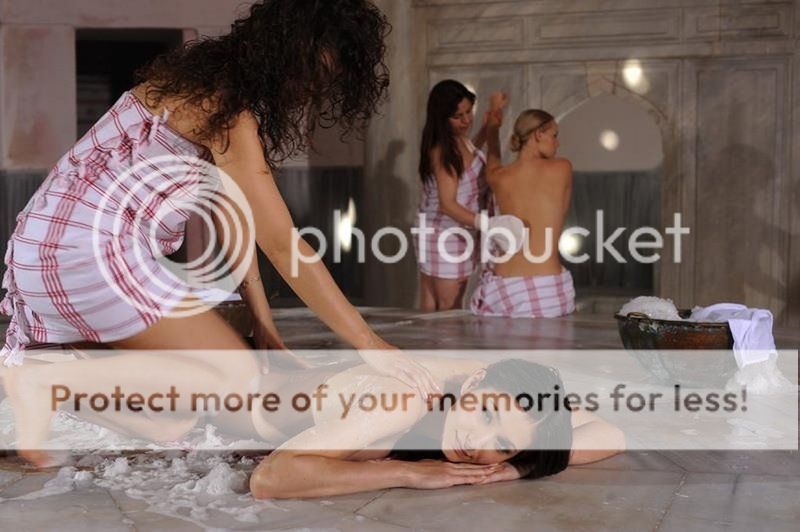
After undressing in the dressing room area the bather will wrap his or her body in the "peştemal," a printed cotton body wrap, before leaving the dressing room. After locking all belongings in the locker provided (remembering to keep the key on his or her person at all times), the bather passes into the hot area that includes the central heating stone platform. This area is called the "hot area" (sıcaklık alanı) and includes the large, hot stone which is surrounded by bathing basins (kurna) and private bathing cubicles (halvet).
The bather should first get his or her body to perspire, either by lying or sitting on the hot stone platform or pouring hot water on the body by sitting next to one of the basins. If you have chosen the second option, the attendant will give you an exfoliating scrub and massage as you lie on the hot platform. You will then move to one of the basins and the attendant will wash you there.
If you prefer, however, you may remain lying on the platform to further perspire and rest and then, when you please, you may move to one of the basins to wash the body. The scrub, massage, and wash by the attendant lasts for approximately fifteen minutes, while the typical bather will remain resting and washing for one to one and a half hours, but there is never a time limit.
If you chose the first option, you will perspire either on the hot platform or nearby areas and then wash yourself at one of the basins.
When you feel ready to leave the bath, you will be given towels to use for drying. When you first enter the bath you should use one "peştemal", but you may use more than one towel for drying.
LOCATION SATELLITE MAP
WEB SITE : Çemberlitaş Hamamı
MORE INFO & CONTACT
Phone : +90 212 522 7974 / +90 212 520 1850
Fax : +90 212 511 2535
These scripts and photographs are registered under © Copyright 2017, respected writers and photographers from the internet. All Rights Reserved.
GPS : 41°00'30.8"N 28°58'18.0"E / 41.008556, 28.971667

PHOTOGRAPHS ALBUM
The Çemberlitaş Bath (Çemberlitaş Hamamı) is located on Çemberlitaş Square on Divanyolu Street situated in the midst of some of Istanbul’s greatest monuments. The bath was established by Nurbanu Sultan, wife of Sultan Selim II and mother of Sultan Murat III, for the purpose of bringing in revenue to support the Valide-i Atik Charity Complex in Toptaşı, Üsküdar. According to the Tuhfet’ül-mi’mârin, the bath is one of the structures built by the architect Sinan, in 1584.
The Çemberlitaş Hamam was planned as a double bath consisting of two identical, side-by-side facilities. The entrance for the men’s section is on Vezir Han Street and, because the road height has increased over time, it now has a deep entrance that is ten steps below street level. There are eaves over the entrance and on top of the entrance door there is an inscription with six lines in three columns.
In the past the entrance for the women’s section must have been from the Divanyolu Street adjacent to the tomb of Sultan Mahmut, but today women also use the men’s entrance and proceed to their own section through a side door. Part of the dressing room in the women’s section was lost when the Divanyolu street was widened in 1868.
The side that was cut off was closed with a wall that has rectangular windows on the bottom and star shaped ones at the top. The dressing room areas of the men and women’s sections are both roofed with large domes. There are three tiers of dressing rooms under these domes that were in the past both illuminated with windowed, dome- top cupolas called "roof lanterns".
Today only the lantern in the women’s section remains in its original state. The dome topped by this lantern rests on arches leaning on fine columns and is elegantly decorated. Today the men’s dressing room area, called the "cold area", is a quiet and restful area used as a resting and waiting place after the bath.
Each of the warm areas of the bath are roofed by three domes. The toilets are reached from this area and have been built as extensions from the building proper. One enters the hot, bathing area from this transitional warm area through a wooden door in the area built under the middle dome. The plan of this hot area is unique as it does not entirely conform to traditional layouts for this bathing area. This can be explained with the fact that the architect Sinan both liked to innovate in his work, and also to the fact that Sinan was closely involved with the construction of the structure.
This space is shaped like a square on the outside, but the inner dimensions are in the shape of a circle formed of twelve columns, becoming a twelve-cornered polygon. The architect beautifully situated the domed, private bathing cubicles, the halvet, in the space made up of the four outer corners outside of the polygon.
Four antechambers are between the cubicle spaces. One enters the hot section by passing through these antechambers. The large dome covering the hot section is supported by high arches on top of columns with baklava shaped heads. The cubicles are separated from the main area by marble slab walls topped by tulip shapes. These dividers have inscriptions carved into each side. The private cubicles are entered through arched doorways at their front sides.
Couplets are inscribed on the front and the triangular shaped upper elements are covered with blossoms. The bath has 38 washing stalls. The multi-faceted central stone platform is directly beneath the wide dome. This broad heated platform is illuminated by the glass globe "elephant eyes" fitted into the overhead dome that catch the light from all directions.
This building dates to Sinan’s last period, one in which his long experience and great skill allowed him to combine functionality, elegance and tranquillity without abandoning his basic style that is devoid of overly decorated elements. For these reasons the architecture of his bath remains a focal point for Turkish and foreign researchers, universities, photographers, filmmakers, media professionals and students.
BATH SERVICES
At the entrance to the bath, the bather will select and pay for one of the bathing options and be given tokens and directions.
After undressing in the dressing room area the bather will wrap his or her body in the "peştemal," a printed cotton body wrap, before leaving the dressing room. After locking all belongings in the locker provided (remembering to keep the key on his or her person at all times), the bather passes into the hot area that includes the central heating stone platform. This area is called the "hot area" (sıcaklık alanı) and includes the large, hot stone which is surrounded by bathing basins (kurna) and private bathing cubicles (halvet).
The bather should first get his or her body to perspire, either by lying or sitting on the hot stone platform or pouring hot water on the body by sitting next to one of the basins. If you have chosen the second option, the attendant will give you an exfoliating scrub and massage as you lie on the hot platform. You will then move to one of the basins and the attendant will wash you there.
If you prefer, however, you may remain lying on the platform to further perspire and rest and then, when you please, you may move to one of the basins to wash the body. The scrub, massage, and wash by the attendant lasts for approximately fifteen minutes, while the typical bather will remain resting and washing for one to one and a half hours, but there is never a time limit.
If you chose the first option, you will perspire either on the hot platform or nearby areas and then wash yourself at one of the basins.
When you feel ready to leave the bath, you will be given towels to use for drying. When you first enter the bath you should use one "peştemal", but you may use more than one towel for drying.
LOCATION SATELLITE MAP
WEB SITE : Çemberlitaş Hamamı
MORE INFO & CONTACT
Phone : +90 212 522 7974 / +90 212 520 1850
Fax : +90 212 511 2535
These scripts and photographs are registered under © Copyright 2017, respected writers and photographers from the internet. All Rights Reserved.
Subscribe to:
Posts (Atom)