Bağlarbaşı, Üsküdar - İstanbul - Turkey
GPS : 41°02'04.4"N 29°02'28.8"E / 41.034551, 29.041330
PHOTOGRAPHS ALBUM
M E N U
DÖNERS
İskender
Pilav Üstü Döner
Fırında Dürüm
Yarım Ekmek Döner
Tam Ekmek Döner
Dürüm Döner
Pide Arası
Üç Çeyrek Döner
CHICKENS
Yarım Ekmek Tavuk
Tavuk Dürüm
Tavuk İskender
Tavuk Pirzola
Tavuk Bonfile
Tavuk Şiş
Tavuk Kanat
Tavuk Sote
Tavuk Güveç
Karışık Tavuk Izgara
Pide Arası Tavuk
Tam Ekmek Tavuk
KEBABS
Beyti Kebap
Halep İşi
Kuzu Şiş
Abu Ganuş
Çöp Şiş
Et Güveç
Karışık Kebap
Et Sote
1,5 karışık Izgara
İçli Köfte
Altı Ezmeli
Adana Dürüm
Adana Kebap
Urfa Dürüm
Urfa Kebap
Çöpşiş Dürüm
Yoğurtlu Kebap
Porsiyon Köfte
Patlıcanlı Kebap
Yarım Ekmek Köfte
Domatesli Kebap
Pide Arası Köfte
Ali Nazik Kebap
Dürüm Köfte
PITAS
Fındık lahmucun
Lahmacun
Karışık pide
Kıymalı Pide
Kuşbaşılı pide
Kavurmalı pide
Kaşarlı pide
Tavuklu Pide
Kaşarlı Sucuklu pide
Beyaz Peynirli pide
SOUPS
Ezo Gelin Çorba
Mercimek Çorba
PİLAFS
Pirinç Pilavı
Bulgur Pilavı
DESSERTS
Fırın Sütlaç
Künefe
Kadayıf
SALADS
Çoban Salata
Mevsim Salata
Karışık Salata
Ezme Salata
Göbek Salata
LOCATION SATELLITE MAP
WEB SITE : Kardeşim Kebap Restaurant
MORE INFO & CONTACT
E-Mail : info@kardesimkebap.com.tr
Phone : +90 216 474 4556 / +90 216 474 4569 / +90 216 651 7719
Mobile : +90 533 460 8243
These scripts and photographs are registered under © Copyright 2019, respected writers and photographers from the internet. All Rights Reserved.
Istanbul is Turkey's most populous city, and its cultural and financial center. It is located on the Bosphorus Strait, and encompasses the natural harbor known as the Golden Horn, in the northwest of the country. It extends both on the European (Thrace) and on the Asian (Anatolia) side of the Bosphorus, and is thereby the only metropolis in the world which is situated on two continents.
Showing posts with label baglarbasi. Show all posts
Thursday, August 22, 2019
KARDEŞİM KEBAP RESTAURANT
Monday, May 8, 2017
ÜSKÜDAR ÇİNİLİ HAMAM since 1640
Bağlarbası, Üsküdar - İstanbul - Turkey
GPS : 41°01'11.2"N 29°01'41.8"E / 41.019778, 29.028278
PHOTOGRAPHS ALBUM
The Çinili Hamam was built in 1640 as part of a mosque complex ordered by the Valide Sultan Mahpeyker Kösem, wife of Sultan Ahmet I (r. 1604-1617) and mother of Sultan Ibrahim I. It was built as Çinili Mosque, library, police office and hamam. Çinili hamam was made for Çinili Mosque’s construction workers. The tiles had been stolen by the burglars. But Hamam’s owners were sticked to its original concept as using blue tiles. Hamam has still its own charm.
Mahpeyker Kösem Sultan was one of the most powerful women of the Ottoman 17th century and gained unprecedented influence in political decision-making when acting as regent, which she did three times, for her son Sultan Murad IV, and her grandson Sultan Mehmed IV. She made enemies as well as allies and was murdered in 1651 at the age of around 70.
Çinili Hamam has a natural heating system. It’ s heated by a boiler in the middle of two domes using woods for heating. It s using approxiamately 1 tons per months in winter and vapour throwing away by the aim of chimneys called "tüfeklik". Çinili Hamam has many differences seperated from the others with its 370 domes. The holes at the bottom of the dome provides sun light getting into the Hamam. In hot days; the lanterns is demounted and provided air to get into the intern area.
Her complex has been divided by modern roads; the baths stand at the junction of Çavuşere Caddesi and Çinili Hamam Sokağı. Taxi drivers may better understand Bağlarbaşı. It’s a 5 minutes drive from the Üsküdar Iskelesi.
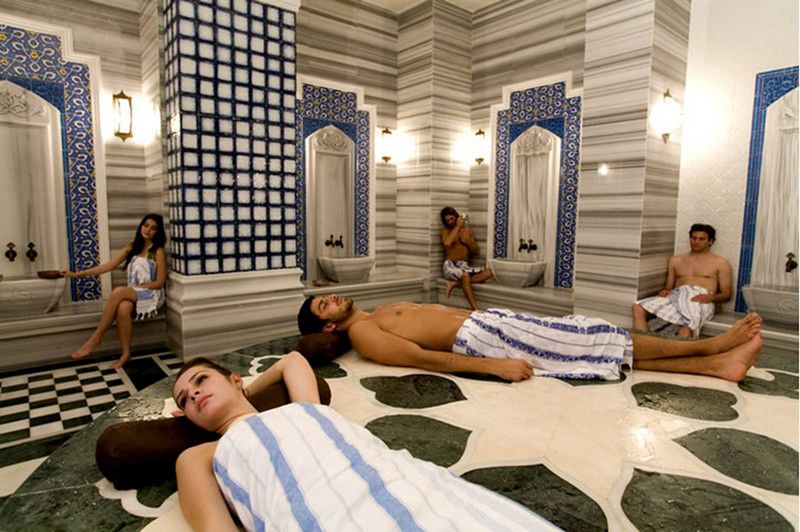
This is a double bath, with separate sections for men and women. There are separate sections for men and women and a fountain at the entrance. Each has two central domed areas, one for the central room and the other acting as a large vestibule for relaxing. The name Çinili (tiled) apparently comes from the quantitities of Iznik tile that decorate both the mosque and the men’s bath, though I have seen neither.
The vestibule has been extensively remade to include small changing rooms on two levels. These have their own charm, but any sense of a gracious space under the dome has been lost along with any original tile - an effect not greatly helped by a quanitity of new, bathroom looking tile, cheap plastic patio furniture, and a space heater. The last is an unfair complaint on a cold day; like most 17th century buildings, this isn’t equipped with central heating.
Around the main domed room are a series of small alcoves alternating with small chambers. These house the faucets and basins which bathers themselves control. These are elegant marble, possibly 17th century, and the rooms are high ceilinged with niches for one’s peştemels (special hamam towels) and other bathing equipment. One of these small chambers is now a sauna; it’s bare-bones but hot and the wood is fragrant. The hamam is very clean and provides plastic flipflops.
There is a usual array of bathing attire. There is a kese (scrub) and soap and massage service, which is administered by one of several employees. The habits of the bathers range from social to serious; some are there to take care of their nails and hair as well as their skin. Clipping and filing is a public activity, but shaving goes on as quietly as possible, usually in a corner. Having a complete wash, which means nudity, also was done discretely, and a clean peştemel or bathrobe donned afterward.
On arrival, guests are guided into their own lockable changing room and given a pestemal, slippers and individual soap.They are then led to the main area which has a large marble slab in the middle and small rooms off to the side with small basins. There is also a sauna available for guests' use.
SERVICES
Bubble Massage
Stroke(Kese)
Oil Massage for Women
Open each day of the week.The opening days are also including offical holidays and festivals. In case you are more than 20 people ,we are able to help you for discount.
In case you are more than 20 people ,we are able to help you for discount.
Timetable
For Men : 07:00 - 22:00
For Women : 08:00 - 19:30
LOCATION SATELLITE MAP
WEB SITE : Çinili Hamam
MORE INFO & CONTACT
E-Mail : info@fcinilihamam.com
Phone : +90 216 553 1593 / +90 216 334 9710
These scripts and photographs are registered under © Copyright 2017, respected writers and photographers from the internet. All Rights Reserved.
GPS : 41°01'11.2"N 29°01'41.8"E / 41.019778, 29.028278

PHOTOGRAPHS ALBUM
The Çinili Hamam was built in 1640 as part of a mosque complex ordered by the Valide Sultan Mahpeyker Kösem, wife of Sultan Ahmet I (r. 1604-1617) and mother of Sultan Ibrahim I. It was built as Çinili Mosque, library, police office and hamam. Çinili hamam was made for Çinili Mosque’s construction workers. The tiles had been stolen by the burglars. But Hamam’s owners were sticked to its original concept as using blue tiles. Hamam has still its own charm.
Mahpeyker Kösem Sultan was one of the most powerful women of the Ottoman 17th century and gained unprecedented influence in political decision-making when acting as regent, which she did three times, for her son Sultan Murad IV, and her grandson Sultan Mehmed IV. She made enemies as well as allies and was murdered in 1651 at the age of around 70.
Çinili Hamam has a natural heating system. It’ s heated by a boiler in the middle of two domes using woods for heating. It s using approxiamately 1 tons per months in winter and vapour throwing away by the aim of chimneys called "tüfeklik". Çinili Hamam has many differences seperated from the others with its 370 domes. The holes at the bottom of the dome provides sun light getting into the Hamam. In hot days; the lanterns is demounted and provided air to get into the intern area.
Her complex has been divided by modern roads; the baths stand at the junction of Çavuşere Caddesi and Çinili Hamam Sokağı. Taxi drivers may better understand Bağlarbaşı. It’s a 5 minutes drive from the Üsküdar Iskelesi.
This is a double bath, with separate sections for men and women. There are separate sections for men and women and a fountain at the entrance. Each has two central domed areas, one for the central room and the other acting as a large vestibule for relaxing. The name Çinili (tiled) apparently comes from the quantitities of Iznik tile that decorate both the mosque and the men’s bath, though I have seen neither.
The vestibule has been extensively remade to include small changing rooms on two levels. These have their own charm, but any sense of a gracious space under the dome has been lost along with any original tile - an effect not greatly helped by a quanitity of new, bathroom looking tile, cheap plastic patio furniture, and a space heater. The last is an unfair complaint on a cold day; like most 17th century buildings, this isn’t equipped with central heating.
Around the main domed room are a series of small alcoves alternating with small chambers. These house the faucets and basins which bathers themselves control. These are elegant marble, possibly 17th century, and the rooms are high ceilinged with niches for one’s peştemels (special hamam towels) and other bathing equipment. One of these small chambers is now a sauna; it’s bare-bones but hot and the wood is fragrant. The hamam is very clean and provides plastic flipflops.
There is a usual array of bathing attire. There is a kese (scrub) and soap and massage service, which is administered by one of several employees. The habits of the bathers range from social to serious; some are there to take care of their nails and hair as well as their skin. Clipping and filing is a public activity, but shaving goes on as quietly as possible, usually in a corner. Having a complete wash, which means nudity, also was done discretely, and a clean peştemel or bathrobe donned afterward.
On arrival, guests are guided into their own lockable changing room and given a pestemal, slippers and individual soap.They are then led to the main area which has a large marble slab in the middle and small rooms off to the side with small basins. There is also a sauna available for guests' use.
SERVICES
Bubble Massage
Stroke(Kese)
Oil Massage for Women
Open each day of the week.The opening days are also including offical holidays and festivals. In case you are more than 20 people ,we are able to help you for discount.
In case you are more than 20 people ,we are able to help you for discount.
Timetable
For Men : 07:00 - 22:00
For Women : 08:00 - 19:30
LOCATION SATELLITE MAP
WEB SITE : Çinili Hamam
MORE INFO & CONTACT
E-Mail : info@fcinilihamam.com
Phone : +90 216 553 1593 / +90 216 334 9710
These scripts and photographs are registered under © Copyright 2017, respected writers and photographers from the internet. All Rights Reserved.
Labels:
baglarbasi,
hamam,
istanbul,
iznik tile,
kese,
ottoman,
pestemal,
scrub,
turkey,
turkish bath,
uskudar
Friday, March 24, 2017
ABDÜLMECİD EFENDİ PAVILION
Bağlarbaşı, Üsküdar - İstanbul - Turkey
GPS : 41°01'41.4"N 29°02'29.5"E / 41.028167, 29.041528

PHOTOGRAPHS ALBUM
This is located on Gümüşyolu Street, accross from the Jewish graveyard. It was built for the last caliph Abdülmecid, when he was a prince. The area, known as the grove of Abdülmecid Efendi, measures about 160 acres. It is located in Bağlarbaşı, and descends down towards Nakkaştepe and Beylerbeyi. Before Abdülmecid, it used to belong to Hidiv Ismail Paşa.
On the enamelled tiles above the gate it is written: "There is no victor but Allah." This statement was used in the palaces, mosques and coins of the Andalusian Ummeyyades.
The same statement can be seen in the Yıldız Palace, which was built by Sultan Abdülhamid II, modeled on the Andalusian palaces. The gate is the most beautifully ornamented pavilion gate in İstanbul. On the walls and above the doors there are written many verses taken from Turkish and Arabic poets.
Abdülmecid Efendi (1 June 1868-23 August 1944) was born in Dolmabahçe Palace as the son of Sultan Abdülaziz and Hayranidil Kadınefendi, in his younger ages he was enrolled in the artillery branch of the army and he was educated by Halil, Hüseyin and Said Paşas. He was interested in horsemanship, hunting, wrestling, fencing and painting and music, he developed his art as a painter.
Abdülmecid Efendi who knew French, Persian, Arabic in good level, learned also German and English as much as to follow the publications. Abdülmecid Efendi who was in close relations with art and literature circles, during his princehood worked in Feriye Palace in winters and in the ateliers situated in Bağlarbaşı Köşkü in summers.
When he became hair apparent, he continued working in Dolmabahçe Hair Section and in his atelier in Dolmabahçe, when he settled here as caliph. Abdülmecid Efendi became the honorary president of the Ottoman Painters Association founded in 1909 and he supported financially for the publication of Ottoman Painters Association Newspaper.
The first of 1914 generation besides supporting Galatasaray exhibitions opened in Galatasaray Dormitory in 1916, he himself participated in this activity by his paintings. The supports and interest of Abdülmecid Efendi for the painting was not limited with this. Another one is the activity named as Şişli Atelier. The art works produced in Şişli Atelier took their place in Vienna Exhibition in 1918 that was the first exhibition opened in Europe by Turkish painters.
Abdülmecid Efendi, participated to 1918 Vienna exhibition by his paintintings, “Otoportre”, “Harem’de Goethe”, “Harem’de Beethoven” and “I.Sultan Selim”. In 1 November 1922 as the sultanate and the caliphate were separated and as Sultan Vahideddin left Istanbul in 17 November 1922, Abdülmecid Efendi was chosen caliph by Turkish Grand National Assembly.
In 3 March 1924 caliphate was abolished by law and the Ottoman Emperor was sent abroad. Abdülmecid Efend first went to Switzerland then to Nice in France and he settled in Paris. In 1944 he died here and he was buried in Medine Cenetül-Baki tomb.
Today, the pavilion is used for the social activities of Yapı Kredi Bank.
LOCATION SATELLITE MAP
WEB SITE : Department of National Palaces / Abdulmecid Efendi Pavilion
MORE INFO & CONTACT
E-Mail : millisaraylar@tbmm.gov.tr
Phone : +90 212 236 9000
Fax : +90 212 259 3292
These scripts and photographs are registered under © Copyright 2017, respected writers and photographers from the internet. All Rights Reserved.
GPS : 41°01'41.4"N 29°02'29.5"E / 41.028167, 29.041528

PHOTOGRAPHS ALBUM
This is located on Gümüşyolu Street, accross from the Jewish graveyard. It was built for the last caliph Abdülmecid, when he was a prince. The area, known as the grove of Abdülmecid Efendi, measures about 160 acres. It is located in Bağlarbaşı, and descends down towards Nakkaştepe and Beylerbeyi. Before Abdülmecid, it used to belong to Hidiv Ismail Paşa.
On the enamelled tiles above the gate it is written: "There is no victor but Allah." This statement was used in the palaces, mosques and coins of the Andalusian Ummeyyades.
The same statement can be seen in the Yıldız Palace, which was built by Sultan Abdülhamid II, modeled on the Andalusian palaces. The gate is the most beautifully ornamented pavilion gate in İstanbul. On the walls and above the doors there are written many verses taken from Turkish and Arabic poets.
Abdülmecid Efendi (1 June 1868-23 August 1944) was born in Dolmabahçe Palace as the son of Sultan Abdülaziz and Hayranidil Kadınefendi, in his younger ages he was enrolled in the artillery branch of the army and he was educated by Halil, Hüseyin and Said Paşas. He was interested in horsemanship, hunting, wrestling, fencing and painting and music, he developed his art as a painter.
Abdülmecid Efendi who knew French, Persian, Arabic in good level, learned also German and English as much as to follow the publications. Abdülmecid Efendi who was in close relations with art and literature circles, during his princehood worked in Feriye Palace in winters and in the ateliers situated in Bağlarbaşı Köşkü in summers.
When he became hair apparent, he continued working in Dolmabahçe Hair Section and in his atelier in Dolmabahçe, when he settled here as caliph. Abdülmecid Efendi became the honorary president of the Ottoman Painters Association founded in 1909 and he supported financially for the publication of Ottoman Painters Association Newspaper.
The first of 1914 generation besides supporting Galatasaray exhibitions opened in Galatasaray Dormitory in 1916, he himself participated in this activity by his paintings. The supports and interest of Abdülmecid Efendi for the painting was not limited with this. Another one is the activity named as Şişli Atelier. The art works produced in Şişli Atelier took their place in Vienna Exhibition in 1918 that was the first exhibition opened in Europe by Turkish painters.
Abdülmecid Efendi, participated to 1918 Vienna exhibition by his paintintings, “Otoportre”, “Harem’de Goethe”, “Harem’de Beethoven” and “I.Sultan Selim”. In 1 November 1922 as the sultanate and the caliphate were separated and as Sultan Vahideddin left Istanbul in 17 November 1922, Abdülmecid Efendi was chosen caliph by Turkish Grand National Assembly.
In 3 March 1924 caliphate was abolished by law and the Ottoman Emperor was sent abroad. Abdülmecid Efend first went to Switzerland then to Nice in France and he settled in Paris. In 1944 he died here and he was buried in Medine Cenetül-Baki tomb.
Today, the pavilion is used for the social activities of Yapı Kredi Bank.
LOCATION SATELLITE MAP
WEB SITE : Department of National Palaces / Abdulmecid Efendi Pavilion
MORE INFO & CONTACT
E-Mail : millisaraylar@tbmm.gov.tr
Phone : +90 212 236 9000
Fax : +90 212 259 3292
These scripts and photographs are registered under © Copyright 2017, respected writers and photographers from the internet. All Rights Reserved.
Labels:
baglarbasi,
caliph,
dolmabahce,
istanbul,
kasri,
ottoman,
turkey,
uskudar
Subscribe to:
Posts (Atom)
