Showing posts with label gulhane. Show all posts

Wednesday, October 24, 2018

HACI BEŞİR AĞA MOSQUE

Gülhane, Fatih - Istanbul - Turkey

GPS : 41°00'38.6"N 28°58'38.1"E / 41.010722, 28.977250


PHOTOGRAPHS ALBUM

A small mosque with an elegant sebil at the street corner. This mosque and its külliye were built in 1745 by Beşir Ağa, Chief of the Black Eunuchs in the reign of Sultan Mahmut I. Hacı Beşir Ağa Complex is located in the Fatih (old Eminönü) District of İstanbul. Hacı Beşir Ağa who was the Chief Eunuch of the Sultan’s Harem (called the Darüssaade Ağası) in the middle of the eighteen centrury (1744-1745).

The complex is consist of a mosque, a library, a madrasa, a tekke (dervish lodge), a sebil (kiosk for the distribution of drinking water or sherbet to passers-by in cups), two fountains, seven shops and a place is attached to the east side of the mosque which could be used as a primary school or a special place for Sultan.

Except from the madrasa and tekke the complex was restorated by The General Directorate for Foundations between the November of 2008 and January of 2010. During the restoration lots of expert (such as architect, restorer, chemist, art historian) worked together as a team and all works have been documented.

LOCATION SATELLITE MAP


These scripts and photographs are registered under © Copyright 2018, respected writers and photographers from the internet. All Rights Reserved.

Tuesday, April 17, 2018

BAB-I SERASKERİ HOSPITAL

Gülhane, Fatih - Istanbul - Turkey

GPS : 41°00'38.5"N 28°58'41.2"E / 41.010694, 28.978111


PHOTOGRAPHS ALBUM

The building has been originally designed by Gasparo Trajano Fossati, and built between 1841 and 1843. The building was conceived to house the Hospital of the Ministry of War (Bab-ı Seraskeri Hastanesi).

Fossati was a Swiss-Italian architect who had designed the Russian Embassy in Pera/Beyoğlu, and who later conducted the works of restoration in Hagia Sophia. The central building of the university had been established two decades later, between 1867 and 1874, to house the Ministry of War and the General Command. In the last quarter of the nineteenth century,

Following the 1908 Constitutional Revolution, and particularly during the armistice years after the First World War, the building was used as a prison for political prisoners. Later, Fossati’s building was used as the headquarters of the Imperial Guard.

İSTANBUL UNIVERSITY, FACULTY OF POLITICAL SCIENCE

When, during the Republican Era, the building complex of the Ministry of War was transferred to Istanbul University, the Fossati Building was used as part of the Faculty of Medicine. The building was transferred to the Istanbul University Faculty of Political Science in the academic year 1980-1981.

The statue that is located at the entrance hall of the faculty has been designed in the 1980s by Ahad Hüseyni, a sculptor of Iranian origin. It consists of the figure of an old, lonely man holding a globe in the end. The globe symbolizes the difficulties and catastrophes that haunt the world. The face of the figure expresses hope from one side, and hopelessness from the other side.

LOCATION SATELLITE MAP


WEB SITE : Istanbul University Faculty of Political Science

MORE INFO & CONTACT
E-Mail : sbf@istanbul.edu.tr
Phone : +90 212 440 0000
Fax : +90 212 440 0203

These scripts and photographs are registered under © Copyright 2018, respected writers and photographers from the internet. All Rights Reserved.

Saturday, July 29, 2017

ARCHAEOLOGICAL MUSEUM / ARTIFACTS

Gülhane - Istanbul - Turkey

GPS : 41°00'41.0"N 28°58'52.0"E / 41.011389, 28.981111
Istanbul Archaeological Museum / Artifacts photo archaeology_artifacts103.jpg

PHOTOGRAPHS ALBUM

NEW BUILDING

Bases Of The Statues Of Charioteer Porphyrios
Ground Floor - Gallery 2 : Those statue bases found in the second courtyard of the Topkapı Palace belong to the Byzantine Era, 5th century AD. They are the bases of statues erected in the Hippodrome, a heavily used entertainment area of Constantinople. The statue was erected for the charioteer Porphyrios by the order of Emperor Anastasius. In one of these bases, each of which has 4 faces, Porphyrios is depicted frontally in a quadriga, standing, holding a palm branch in his left arm and an object in his raised right arm. The bases, which have Greek inscriptions too, give information about horse races held in the Hippodrome as well.

Tomb Monument Of The Praefectus And High Priest
Ground Floor - Gallery 2 : On this tomb monument dated to the Roman Era, 1st century AD and found in Marmara Ereğlisi, a town in the Marmara region of Turkey, the armored Tiberius Flavius is depicted at the center on his rearing horse. There are 2 Roman soldiers standing on the right side and 3 on the left side.

Palmyran Tomb Chamber
3rd Floor - Gallery 1 : The tomb chamber reproduced for the museum was built by a rich Palmyran family for at least 219 persons. The original tomb is in the Valley of Tombs in Palmyra, but the portraits in the model constructed for the museum are original. The corpses were placed in drawer-like tomb compartments lined up vertically and horizontally and limestone slabs with human busts in high relief and with inscriptions of identity sealed the openings of the compartments. Hypogeum or underground tombs were rich monumental tombs preferred by Palmyrans in the 1st and 2nd centuries AD, besides tower tombs and house tombs.

SILOAM INSCRIPTION
3rd Floor - Gallery 1 : It was found in the underground tunnel that feed water to the Pool of Siloam in Jerusalem. This inscription, the oldest Hebrew text written with the Phoenician alphabet, was cut in the rock on the left side of the tunnel, near to the Siloam Pool end. It consists of six lines of different lengths. The tunnel dug through rocks, of which construction is described in the inscription, was feeding water from the Gihon Spring out of the city to the Pool of Siloam in the city. Its construction was ordered by King Hezekiah (725-697 BC). The tunnel is mentioned in Bible's section of 'History of Rulers'.

SIMURGH RELIEFS
Ground Floor - Gallery 2 : On the reliefs dated to the Byzantine Era, 10th century AD, Simurgh is depicted with a wolf head and a body of lion with a tail. This figure, which entered the Byzantine art under the influence of Sassanians who had ruled in Iran, became a widely used mythological figure depicted on textiles, stones and silverware as well.

GEZER CALENDAR
3rd Floor - Gallery 1 : This inscription, made in the 10th century BC and called the Gezer Calendar include the names of months and harvest periods. It is one of the oldest known examples of Hebrew writing.

STATUE OF MARSYAS
3rd Floor - Gallery 1 : The Statue of Marsyas, dated to the Hellenistic period, was found in Tarsus, a historical city in south-central Turkey. He is depicted as hung from a tree and his muscles stretched due to torture draw attention. So to say, he has a physically silent but angry expression. The original version of this special statue should have been placed to the center of a group of statues including the statue of Apollo sitting on his left side and a slave sharpening his knife in order to skin him on his right side.

Marsyas, the main character of an Anatolian story, is depicted while bearing the consequences of his rivalry with Apollo, the god of music. According to the story, Marsyas claims that he plays his flute better than Apollo plays his lyre. Neither of them wins in a musical contest, but Apollo asks Marsyas to turn his instrument upside down and to add his own voice. However, Marsyas cannot meet this challenge and Apollo wins the contest. Angry because of being challenged by a mortal, Apollo skins Marsyas alive and hangs his skin to a pine tree. However, he feels sorry later, breaks his lyre and turns Marsyas into a river.

TUMULUS OF VİZE
Ground Floor - Gallery 2 : The tumulus found in the province of Kırklareli is dated to the 1st century AD. The helmet with a mask, which is the grave gift of this tumulus, reflects the portrait of a young man. It has two parts, the mask and the helmet, which are connected above the forehead with a hinge. On the front plate, there is a mythological scene: Scylla, the most horrible sea monster who smashed the ship of Odysseus, who sacrificed 6 of his ships, is depicted. On the cheek guards, there are depictions of Nike carrying spoils of war.

GROUND FLOOR

Head Of Alexander The Great
Gallery 16 : When the Macedon king Alexander the Great, who lived between 356 and 323 BC, ascended to the throne, he was not even twenty. The legendary commander, who died at the age of 33, has never been forgotten during the twenty-three centuries passed since then, thanks to his glorious and great conquests during a short period of kingdom. He overthrew the Persian Empire and established a great empire extending from Macedonia to India.

The cities founded by Alexander, who spent most of his life in Asia, as military bases turned into cultural and commercial centers later and played an important role in the spread of the Ancient Greek culture up to India. The era of Alexander the Great, of which artistic influences can be followed as well, was a transition period between the periods of Classical Art and Hellenistic Art. The Head of Alexander the Great, dated to the 2nd century BC, was found during excavations at the Lower Agora in Pergamon (Bergama).

His head is inclined towards his shoulder, the lock of hair from the front of his head, slightly pulled back, resembles a lion's mane and his hair is irregularly waved in both sides. This is the hairstyle of Alexander the Great. All of the aspects such as his heavy eyelids and round eyes, thick eyelashes, slightly open mouth that does not show his teeth are characteristics of the statues of Alexander the Great.

This is the style of portraits made by the sculptor Lysippos, who lived in the 4th century BC and led the transition between the Classic Art and the Hellenistic Art. The artist worked for Alexander the Great and he was the only sculptor of Alexander. The deep forehead lines call the big problems faced by the king despite his youth to the mind. This work is reflecting the typical characteristics of the Pergamon sculpture school during the era of King Eumenes II.

SARCOPHAGUS OF THE CRYING WOMEN
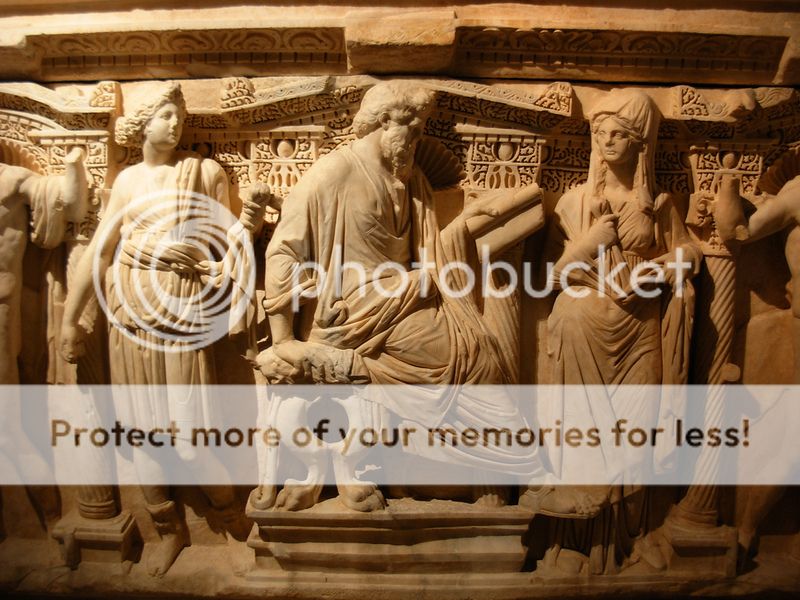
Gallery 8 : In the Sarcophagus of the Crying Women, found at the Royal Necropolis in Sidon like the Alexander Sarcophagus, nothing could be found other than the bones of its owner and a bronze belt buckle, since it had been robbed in an earlier time. From the partial traces on the marble that remained until today, it is understood that it had been dyed in blue and red initially. It is the best example of the group called by archaeologists "Sarcophagi with Columns", and it is considered as a final resting place, like the "Mausoleum of Halicarnassus" or the "Nereid Monument", rather than a tomb.

Its architectural features were used in the architecture of the old building of the İstanbul Archaeological Museums. It is an example of the Greek sculpture displaying Eastern influences. The shaved heads, bear feet, ragged clothes of the figures and their movements and expressions of sadness are features of Semitic societies. It is thought to be the sarcophagus of the King of Sidon, Straton (374-358 BC), who was said to have led a life of pleasure. The sarcophagus has the shape of an Ionian temple. It is thought that the figures of 18 sad women between the columns represent the wives of the dead person or the women in his seraglio, rather than crying women who were common in the Middle Eastern countries.

ALEXANDER SARCOPHAGUS
Gallery 8 : The Alexander Sarcophagus is considered as the most important artifact in the İstanbul Archaeological Museums. It was found in the Royal Necropolis in Sidon in 1887. Though it is called the Alexander Sarcophagus, in fact, it does not belong to Alexander the Great. It is thought to be the sarcophagus of Abdalonymus, the king of Sidon. .

On the front side of the sarcophagus, Alexander is shown on his horse. Since Alexander claimed descent from Heracles, he is depicted with the skin of the Nemean Lion on his head. Additionally, next to his ear, a ram horn, the symbol of the Egyptian god Amun is seen. Because of this depiction on the sarcophagus, it was named after Alexander. In fact, Alexander the Great died in Babylon and his body was transferred to Alexandria. It is known that his sarcophagus was an anthropoid one.

On one of the long sides of the sarcophagus, there is a scene of battle between Persians and Greeks. Greek and Persian soldiers can easily be distinguished thanks to their outfits. Greeks have short tunics or cloaks, whereas Persian soldiers, who had to cover all parts of their bodies excluding their faces and fingers, wear trousers, more than one long-sleeved shirts and tiaras covering their heads. The scene of battle is thought to represent the Battle of Issus, won by Alexander the Great in 333 BC and opened the doors of Phoenicia and Syria.

As a result of this battle, the fate of Abdalonymus, who is thought to be the owner of the sarcophagus, changed and he became the king of Sidon after a while. Two hunting scenes are depicted on the second long side of the sarcophagus. It is known that hunting with horses and carriages was usual for Near Eastern civilizations and that Alexander the Great participated in such events in Phoenicia.

It is accepted that Alexander's aim was to establish a Greek-Persian empire through uniting Eastern and Hellenistic cultures after conquering Iran. Towards the end of his life, he married a Persian princess, started to wear Persian clothes and accepted Persian dynastic customs. The Persians and Greeks who friendly hunt on one side of the sarcophagus should be considered within this perspective. It is known that after defeating Darius III in Issus, Alexander the Great passed through the Amanus Mountains and entered Syria following the Mediterranean shores.

The people of Sidon, who disliked the Persian administration, opened the doors of the rich cities to the Macedon army and asked Alexander the Great to choose a king for them. Alexander, who had no time to choose a king for Sidon, gave this job to Hephaestion. He found Abdalonymus, who was a distant relative of the royal dynasty of Sidon but who had a quiet life in the country until chosen as the king. The name of Abdalonymus means "servant of gods" in Persian and the Alexander the Great and Hephaestion depictions were therefore added to the sarcophagus ordered by him.

When the carvings are analyzed, it is understood that those who made this sarcophagus were masters of the Eastern art of decoration. The upper row of the acroter consists of eagles, partially with no remains other than pieces of wings, and women heads. In the Ancient Syria, it was believed that eagles were birds carrying the souls of dead people to heaven.

Nine smaller women heads that line up at the bottoms of each of two sides bring the mother goddess worshipped since the prehistoric periods of Anatolia and Mesopotamia to mind. Upper acroters of the both pediments are decorated with Persian griffins and herbal figures. At each of the corners of the pediment, a lion is placed as sarcophagus protectors. Those lions with thin necks and small bodies, which resemble dogs, are elements belonging to the Ionian art.

Both the body and the cover of the sarcophagus is made of the same kind of marble. The carvings on the sarcophagus are so fine that it is thought that this artifact should have been made in Sidon since it would have been too dangerous to transfer such a work from Greece to Lebanon. There is no information about its sculptor. Painters of the sarcophagus should have been masters of their job as well. It seems that the eyes, eyelashes, lips and clothes were dyed in purple, yellow, blue, red and violet, and that the figures were slightly varnished.

STATUE OF OCEANUS
Gallery 19 : The statue brought from Ephesus and dated to the 2nd century AD depicts the River God Oceanus while he lies on a rocky ground. The god is shown as an old man, but his muscles are strong despite his age. His left arm is resting on a container resembling a big jug. Oceanus is a son of Uranos and Gaia. He is considered to be an enormous river encircling the world. He is the father of all streams. He married his sister Tethys, who represented the fertility of the sea, and they had many children. Their sons are streams and rivers, and their daughters are creeks and spring waters.

STATUE OF AN EPHEBOS
Gallery 17 : This is the statue of an ephebos, i.e. a male teenager. Probably he is an athlete and after a heavy exercise, he rests against a long, rectangular column, which once had a relief or herm. He should have just finished his exercise, since he wears a mantle-like cloth for protection. His small and round head is the most component of the statue. Eyelashes are apparent, eyes are big and the lips are slightly open. It is one of the unique ancient artifacts found until today. Probably, it was used to decorate a gymnasium. It is an important example, since it shows that not only gods, goddesses and emperors, but also ordinary people who were important for the society were portrayed in the ancient era.

MILETUS - BATHS OF FAUSTINA STATUE GROUP
Gallery 19 : This statue group depicting the god Apollo and his muses, i.e. sources of inspiration, was found at the Baths of Faustina in the ancient city of Miletus and it is dated to the 2nd century AD. Faustina was the daughter of Roman Emperor Antoninus Pius and the wife of Emperor Marcus Aurelius. After her death, the famous baths of Miletus were named after her.

In this statue group, Apollo, the god of light, wisdom and reason, is depicted as a muscled young man. He is playing his lyre placed on a pedestal. His facial expression is celestial and cool. His body is elegant and well proportioned; it is shaped very orderly like that of a women. As if he is playing with the strings before starting to play, he is holding the plectrum of the lyre. That kind of depictions of the god is known as the "Apollo Citharoedus" or "Lyre Playing Apollo".

STATUE OF TYCHE
Gallery 20 : This is a copy of an artifact dating from the 4th century BC made in the Roman Era, in the 2nd century AD. That richly decorated artifact was found in Üskübü, Bolu. Goddess Tyche wears a crown representing the city wall and ornamented with olive leaves. She holds a horn of plenty full of various fruits and a child named Plutus, the symbol of wealth, in her left arm. Tyche is a daughter of Oceanus. She is the goddess of fate, luck and success. Every city has a Tyche. Tyche's are guardian goddesses of cities and they are depicted with crowns shaped like city walls.

HEAD OF SAPPHO
Gallery 18 : The Head of Sappho, an example of the portraits from the Roman Era, belongs to poet Sappho, born on the island of Lesbos (Midilli). Between 7 to 5th centuries BC, there were many lyric poets. Sappho was the most famous poet of that era, but only one of here poems, a hymn to Aphrodite, remained as a whole since then. Sappho, who lived far away from Lesbos, in Sicily, during her youth, became the teacher of a group of women worshipping Aphrodite after her return. According to a legend, she killed herself by jumping off cliffs when she was rejected by her beloved man.

LOCATION SATELLITE MAP


WEB SITE : Istanbul Archaeological Museums Administration

MORE INFO & CONTACT
Tel : +90 212 520 7740
Fax : +90 212 527 4300
E-Mail : info@istanbularkeoloji.gov.tr

These scripts and photographs are registered under © Copyright 2017, respected writers and photographers from the internet. All Rights Reserved.

İSTANBUL ARCHAEOLOGICAL MUSEUMS

Gülhane - Istanbul - Turkey

GPS : 41°00'41.0"N 28°58'52.0"E / 41.011389, 28.981111

Istanbul Archaeological Museum photo archaeology_museum115.jpg

PHOTOGRAPHS ALBUM

Istanbul Archaeology Museum established in 1881, is one of the largest and most famous archaeological museums of its kind in the world. The museum houses over one million archaeological objects that represent almost all of the eras and civilizations in world history, i.e., the Mediterranean basin, the Balkans, the Middle East, North Africa and Central Asia.

The İstanbul Archaeological Museums, a museum affiliated to the Ministry of Culture and Tourism, is located in İstanbul's Sultanahmet neighborhood, on the Osman Hamdi Bey slope connecting the Gülhane Park with the Topkapı Palace. Its name is plural, since there are three different museums under the same administration: The Archaeological Museum, the Ancient Orient Museum (Eski Şark Eserleri Müzesi) and Tiled Kiosk Museum (Çinili Köşk Müzesi).

During an İstanbul Archaeological Museums tour, it is possible to visit the extraordinarily beautiful garden of the museum and the three different buildings inside this garden. The İstanbul Archaeological Museums, which is housing various artifacts from civilizations that had left their traces to different periods of the history, is one of the 10 most important world-class museums designed and used as a museum building.

Additionally, it is the first institution in Turkey arranged as a museum. Besides its spectacular collections, the architectural aspects of its buildings and its garden are of historical and natural importance. The İstanbul Archaeological Museums is welcoming all visitors who want to make a journey in the corridors of the history and to trace the remains of ancient civilizations.

*Classical Section
Troy Collection, Glassware Collection, Terra Cotta Ware Collection, Metal and Ornamental Ware Collection, Treasury, Pottery Collection, Stoneware Collection, Islamic Coins Section, Non-Islamic Coins Section, Islamic Coins Section, Non-Islamic Coins Section
*Ancient Orient Museum
*Tiled Kiosk Museum

THE ARCHAEOLOGICAL MUSEUM and THE NEW BUILDING

Main Building (Old Building)
Its construction was started in 1881 by Osman Hamdi Bey and with the additions in 1902 and 1908 it gained its latest form. Its architect is Alexander Vallaury. The outer face of the building was made by inspiring from the Iskender Tomb and Crying Women tombs. It is a beautiful example of neoclassical buildings in Istanbul. On the upper floor of the two-storey building, there are the Treasury section, the Non-Islamic and Islamic Coin Cabinets and the Library.

On the upper floor of the two storey building there are small stone works, pots and pans, small terracotta statues, the Treasure Department and approximately 800.000 Ottoman coins, seals, decorations, medals and Non-Muslim and Muslim Coin Cabinets, in which coin moulds were kept, and a Library with approximately 70.000 books. On the bottom floor saloons of the building, famous tombs are displayed such as Iskender Tomb, Crying Women Tomb, Satrap Tomb, Lykia Tomb, Tabnit Tomb that are in the Sayda king graveyard.

On the bottom floor, besides the display of tombs, there is Old Age Statuary display in which statues and reliefs from important antic cities and regions are displayed. In this display, the development of the art of statuary from the Archaic Period to the Byzantium Period is displayed in chronological order with outstanding examples.

Additional Buildings (New Building)
The additional building attached to the southeast of the main building is of 6 storeys. There are depots in the two storeys under the ground floor. The four storeys of the building are arranged as exhibition saloons. There is an inscription “Istanbul for Ages” on the first floor of the building, "Anatolia and Troia for Ages" on the second floor and "Surrounding Cultures of Anatolia: Cyprus, Syria-Palestine" on the top floor.

After its opening on June 13, 1891, the Archaeological Museum expanded its collection rapidly. Currently, on the ground floor of the Archaeological Museum, sculptures from the Ancient Age from the Archaic Era to the Roman Era may be seen on the right side, and world wide famous unique artifacts such as the Alexander Sarcophagus, the Sarcophagus of Crying Women and the Sarcophagus of Tabnit that came from the Royal Necropolis in Sidon on the left side.

The "Surrounding Cultures of İstanbul" section, which was opened in the cellar of the new building in 1998, is a hall where artifacts from various ages found during excavations at the surrounding archaeological sites and tumuli. It has sub-sections of "Thrace-Bithynia and Byzantium". The ground floor of the new building hosts the "Children's Museum" exhibition.

The "İstanbul Through the Ages" collection is exhibited on the first floor of the new building, the "Anatolia and Troy Through the Ages" collection on the second floor and the "Surrounding Cultures of Anatolia: Artifacts from Syria, Palestine and Cyprus" collection on the third floor, in chronological order.

LOCATION SATELLITE MAP


WEB SITE : Istanbul Archaeological Museums Administration

MORE INFO & CONTACT
Tel : +90 212 520 7740
Fax : +90 212 527 4300
E-Mail : info@istanbularkeoloji.gov.tr

These scripts and photographs are registered under © Copyright 2017, respected writers and photographers from the internet. All Rights Reserved.

Tuesday, July 25, 2017

ANCIENT ORIENT MUSEUM

Gülhane, Fatih - Istanbul - Turkey

GPS : 41°00'40.1"N 28°58'48.8"E / 41.011153, 28.980223

Ancient Orient Museum photo ancientorient_museum108.jpg

PHOTOGRAPHS ALBUM

This museum is sperate section of the Archeological museum. It was originally built by Osman Hamdi Bey  in 1883 as Sanayi-i Nefise (Fine Arts School), the famous Ottoman painter and director of the Archeological Museum, as the first fine arts academy in Turkey. When the academy moved to Cağaloğlu in 1917, the building was converted into a museum and put under the direction of the scholar Halil Ethem. The building was later restored in the years between 1963 and 1973.

This is the first building to the left at the entrance of the Archeological Museum. Originally a school building, it was converted into a museum in 1917, and then modernized between 1963-1973. The artifacts brought here from Egypt and the Middle Eastern countries that were under Ottoman rule prior to World War I, and relics from ancient Anatolian civilizations comprise a unique and beautiful collection.

The collections of the Ancient Orient Museum consists of artifacts from pre-Greek Anatolia and Mesopotamia and from pre-Islamic Egypt and Arabian Peninsula. Most of these artifacts were found during archaeological excavations carried out between late 19th century and the World War I, and brought to İstanbul, the capital of the Ottoman Empire, then the ruler of those countries.

The Ancient Orient Museum consists of the sections of Pre-Islamic Arabian Art, Egypt Collection, Mesopotamia Collection, Anatolia Collection, Urartu Collection and Cuneiform Documents, arranged according to regions; the cultures of the Arabian Peninsula, Egypt, Mesopotamia and Anatolia have been presented in historical order.

On the upper floor of the two-storey building, Anatolian, Mesopotamian, Egyptian and Arabic works of art are displayed. Statue of Naramsin, the king of Akad, the Kadeş Agreement, the Ishtar Gate and Zincirli statue are the unique works of art in the museum. Moreover, in this museum there is a "Tablet Archive" in which 75.000 documents with cuneiform writings are kept.

Two basalt neo-Hittite lions are placed at the entrance. The Mesopotamian, Egyptian and Anatolian sections are on the second floor. Some of the pieces on display are artifacts from the old and new Sumerian, Assyrian and Babylonian civilizations, the graves of the pharaohs and Arabic tomb stone, as well as Hatti-Hittite and Urartu relics. The museum has a very rich and rare collection of cuneiform inscriptions consisting of 70 thousand tablets.

This museum contains a rich collection of ancient Anatolian archeological finds, including Urarthian, Hittite,Akkadian, Babylonian,Sumerian, Assyrian and Aramaic objects, as well as seals from Nippur and a copy of the code of Hammurabi. There is also a considirable collection of pre-Islamic artifacts from the Arabian peninsula and ancient Egypt.

ANCIENT ORIENT MUSEUM ARTIFACTS

DEVOTIONAL STATUETTES
Gallery 1 : The statuettes sitting on patios are cubic human figures and the heads have been more carefully processed in comparison with bodies. In Timna, an ancient city in Yemen, many devotional statuettes similar to these statuettes were found in the sacred place in the cemetery. Therefore, it is thought that these should also be devotional statuettes. They are dated to circa 4th-1st centuries BC.

THE OLDEST LOVE POEM
Gallery 5 : This inscription, dating from the 8th century BC and belonging to the Ancient Babylonian Era, is described as the world's oldest known love poem. According to the Sumerian belief, it was a sacred duty for the king to marry every year a priestess instead of Inanna, the goddess of fertility and sexual love, in order to make the soil and women fertile. This poem was most probably written by a bride chosen for Shu-Sin in order to be sung at the New Year festival and it was sung at banquets and festivals accompanied by music and dance.

Its translation:

Bridegroom, dear to my heart,
Goodly is your beauty, honeysweet,
Lion, dear to my heart,
Goodly is your beauty, honeysweet.

Bridegroom, let me caress you,
My precious caress is more savory than honey,
In the bedchamber, honey-filled,
Let me enjoy your goodly beauty,
Lion, let me caress you,
My precious caress is more savory than honey.
Bridegroom, you have taken your pleasure of me,
Tell my mother, she will give you delicacies,
My father, he will give you gifts.

You, because you love me,
Give me pray of your caresses,
My lord god, my lord protector,
My SHU-SIN, who gladdens ENLIL's heart,
Give my pray of your caresses

CODE OF HAMMURABI
Gallery 5 : Hammurabi was the sixth one of the 11 kings of the Old Babylonian Dynasty. He ruled 43 years long, between 1792 and 1750 BC. The second year of his rule is the year "when the code was enacted". The original version was inscribed on 2.23 m tall diorite stele. This stele was found in Susa and transferred to the Louvre Museum. The code consists of 282 laws and three sections. The version displayed in the İstanbul Archaeological Museums was one of those copied to tablets to be used in schools and courts, and it was found in Nippur.

TREATY OF KADESH
Gallery 7 : The Treaty of Kadesh, the earliest peace treaty known, was concluded between the two big political and military powers of the 13th century BC, the Hittite and Egyptian empires. The clay tablet containing the text of this treaty sealed by Hattusili III, the king of the Hittite empire and the Egyptian Pharaoh Ramesses II was found during excavations at Boğazköy in 1906.

Before the emergence of this artifact, only the text of this treaty carved on a stele in the Egyptian Tempel of Karnak in Egyptian hieroglyphs was known. In the inscription, it is stated that Hattusili III had made the text of the treaty carved on a silver plate and sent to Egypt; but this version could not be found yet. The tablet in Akkadian, then the language of diplomacy, had many missing pieces and contained only about half of the text. During later excavations, four pieces belonging to the main text were found and the missing parts were completed. The text of the treaty sealed under equal conditions reads:

"It is concluded that Reamasesa-Mai-amana (the cuneiform transcription of Ramesses II) , the Great King, the king (of the land of Egypt) with Hattusili, the Great King, the king of the land of Hatti, his brother, for the land of Egypt and the land of Hatti, in order to establish a good peace and a good fraternity forever among them." Later, information about the ancestors of the two kings and their efforts aimed at achieving peace are described repeatedly, before the articles of the treaty. Those articles may be listed as follows:

"If domestic or foreign enemies marches against one of these two countries and if they ask help from each other, both parties will send their troops and chariots in order to help. If a nobleman flees from Hatti and seeks refuge in Egypt, the king of Egypt will catch him and send back to his country.

If people flee from Egypt to Hatti or from Hatti to Egypt, those will be sent back. However, they will not be punished severely, they will not shed tears and their wives and children will not be punished in revenge."

Since it is the first written peace treaty in the history, a 2-meter long copper copy of the original tablet was hanged on a wall of the United Nations building.

YERKAPI SPHINX
Gallery 7 : The limestone sphinx dated to the 13th century BC was found in Yerkapı (literally "ground gate"), on the upper city walls of Boğazköy, capital of the Hittite Empire. An identical sphinx is in the Berlin Museum. It is one of the four sphinxes located at the entrance and exit for purposes of protection. It was completed by assembling many pieces. As this lion-bodied and human-headed sphinx wears the head-dress of Hathor, one of the goddesses of Egypt, it reflects the heavy Egyptian influence in the art of Hittites. Probably, there had been gemstones in the currently hollow and empty eyes of the statue, which is one of the outstanding examples of the Hittite sculpture.

ISHTAR GATE
Gallery 4 : The aurochs and dragon reliefs formed by terracotta and glazed and embossed bricks belong to the monumental double-gate connecting the inner and outer walls of Babylon, the capital of the Neo-Babylonian Empire, dedicated to goddess Ishtar. The walls of the gate are ornamented with reliefs of aurochs, the holy animal of the god Adad, and the dragon sirrush (or mushhushshu), the holy animal of Babylon's chief god, Marduk. Meanwhile, the reliefs of lion, the holy animal of the goddess Ishtar, were ornamenting the two sides of the Processional Way. The monumental way was starting from the temple of Marduk in the city center, passing the Ishtar Gate and ending at the "feast house" outside the city wall, where the New Year's celebration was held. The Ishtar Gate and the Processional Way were built during the era of Nebuchadnezzar II, the most glorious period of the Neo-Babylonian Era, in late 6th century BC. A model of the gate and the processional way is displayed too. Many elements of the structure are in the Pergamon Museum in Berlin. .

STELE OF NARAM-SUEN
Gallery 3 : According to the inscription on the diorite piece of stele, it belongs to King Naram-Suen (also transcribed Naram-Sin). It was found in Pir Hüseyin, a village near Diyarbakır. As it shows the borders of the Akkadian State in the era of Naram-Suen and reflects the artistic features of that era, it is one of the most important evidences about the Akkadian culture. King Naram-Suen, who ruled in the 3rd millennium BC, entitled himself as the "King who brought peace to 4 regions".

This title is representing the 4 principal directions and symbolizes Naram-Suen's becoming the "King of Universe" after conquering the cities of Ebla and Elam, i. e. the west and the east. Dynamism, the most apparent feature of the Akkadian art, may be seen in this stele. In similar steles, the weapons in the hands of kings symbolize the authority of the king, rather than concrete tools used during battles. Additionally, the kings depicted in this manner, announce that they personally assume the responsibility of protecting the people and goods entrusted to them.

STATUE OF LUGALDALU
Gallery 4 : The most important artifact from the ancient city of Adab is the limestone statue of Lugaldalu. The inscription on its shoulder introduces him as the "King of Adab" and the statue is stated to have been devoted to E-shar, the temple of the chief god of Adab. Lugaldalu, who was not listed in the Sumerian king lists, is thought to be a governor of Adab in circa mid-3rd millennium BC. This is one of the 'deputy priest' statues placed in the temples according to the Sumerian belief. Those statues continued to express gratitude to the god on behalf of persons they were representing, when they were out of the temple.

EGYPTIAN TOMB FINDS
Gallery 2 : In the Ancient Egypt, it was believed that the soul was returning, after leaving the body with death. Since the belief in afterlife was very widespread and deep-rooted, tomb finds constitute a large part of Egyptian artifacts that reached today. It was believed that afterlife could only be normal in case of the existence of the body. Therefore, depending on their social positions, Egyptians were buried in monumental tombs such as pyramids, mastabas and rock-cut tombs or in ordinary graves dug into sand.

In the monumental tombs, the mummy was placed into two or three nested sarcophagi. The wooden, anthropoid sarcophagi were found during excavations at Deir el-Bahri, the burial place of the city Thebes. They belong to the priests and priestesses of the temple of God Amun, the Lord of Thebes. Inner and outer surfaces of the sarcophagi were plastered with thin layers of gypsum and they were ornamented with religious texts, charmed symbols that would protect the dead in the afterlife and mythological scenes.

In a sarcophagus displayed uncovered, the mummies of Bak-Na-Mut and his cat next to his feet are seen. The internal organs extracted before mummification were mummified and placed into canopic jars. The lids of these jars were the heads of the four gods guarding dead persons. The stomach was stored in the jar of falcon-headed Imseti, the lungs in the jar of baboon-headed Hapi and the liver in the jar of falcon-headed Horus. Sometimes, the mummy was covered with bead nets, wooden pillows were placed under its head and bead baskets made of straw were placed into the tomb chamber.

SUNDIAL
Gallery 1 : This sundial, which has a concave surface divided into 12 equal segments with eleven radial lines, was found in Mada'in Saleh, Saudi Arabia. It has an Aramaic inscription and it is made of red sandstone. The shadow of the perpendicular rod at the center falls on different lines according to the movement of the Sun and it shows the time.

LOCATION SATELLITE MAP


WEB SITE : Ancient Orient Museum

MORE INFO & CONTACT
Tel : +90 212 520 7740
Fax : +90 212 527 4300
E-Mail : info@istanbularkeoloji.gov.tr

These scripts and photographs are registered under © Copyright 2017, respected writers and photographers from the internet. All Rights Reserved.

Sunday, December 18, 2016

GOTHS COLUMN

Gülhane Park, Fatih - Istanbul - Turkey

GPS : 41°00'51.0"N 28°59'07.0"E /41.014167, 28.985278

 photo goth_column102.jpg

PHOTOGRAPHS ALBUM

The Goths Column is found at the entrance to the Gülhane Park from Sarayburnu. and is thought to have been built in the 4th century. It was erected after a military victory over the Goths. It is the oldest monument in the city that has survived intact from the Roman period.

One of the most beautiful monuments of Constantinople is this granite monolith. It can be found immediately north of the famous Topkapı Palace, overlooking the Bosphorus. According to the inscription, it was erected to commemorate how the Romans had defeated the Goths. The Byzantine author Nicephorus Gregoras says that on top of the column stood a statue of the legendary founder of Byzantium, king Byzas.

The column is 15 meters high and rests on a three-step pedestal. The column is carved from a single piece of stone. The Corinthian capital is decorated with a coat of arms depicting eagles. It is almost hidden by the tall trees surrounding it.

The name of the 18.5 metre high free-standing Proconnesian marble pillar which is surmounted with a Corinthian capital derives from a Latin inscription at its base, commemorating a Roman victory over the invading Goths: FORTUNAE REDUCI OB DEVICTUS GOTHOS (To Fortuna, who returns by reason of victory over the Goths), which has been shown to have replaced an earlier Latin inscription. The dating and original dedication of the column are uncertain.

Most likely, the column was erected to honor the victories of either Claudius II Gothicus (r. 268-270) or Constantine the Great (r. 306-337), both of whom are noted for achieving victories over the Goths. According to Byzantine historian Nicephorus Gregoras (c. 1295-1360), the column was once surmounted by a statue to Byzas the Megarian, the semi-legendary founder of Byzantium.

Other sources mention a statue of the goddess Tyche, now lost. At any rate, it represents the oldest monument of the Roman era, possibly preceding the foundation of Constantinople, still extant in the city.

During the 3rd century for the first time the Roman limes (fortified border) on the Danube River was crossed by nomadic tribes and the Goths laid siege to Byzantium. A column was erected to celebrate the decisive victory of Emperor Claudius II (268-270) against the Goths at Naissus (today's Nis in Serbia).

In 272 Constantius Chlorus, the military commander of Naissus had a child by an innkeeper's daughter: He was to become Emperor Constantine and to play a major role in the future of Byzantium (some believe the column celebrated Constantine's victories).

It is not entirely clear for which commander this column was erected. Several generals defeated the tribes north of the Danube that the Romans, using archaisms that went back to Herodotus of Halicarnassus, called Scythians, Getae, or Goths, no matter how the tribes called themselves. One of the most famous Roman victories was achieved by the Emperor Claudius II Gothicus, who defeated the Herulians in 269.

It is certainly possible that this event was commemorated with the Column of the Goths. Another candidate is Constantine the Great, who overcame the Sarmatians in 315, 322, 328-329, and 332, and is known for his building activities in Constantinople.

On balance, however, Claudius II appears to be the more likely candidate, because Constantine would not have permitted a statue of the founder of the city that he had refounded, and - moreover - is not known to have erected monuments in this part of the city, the ancient Acropolis.

Although it is not entirely clear how Christian Constantine was, it is reasonably clear that he sympathized with this monotheism, and did not pay much attention to the pagan temples, of which there were many on the Acropolis.

In fact, this pagan part of the city was left abandoned for centuries, until the Ottomans decided to build the Topkapı palace on this unused grounds. Although this does not prove that the column was erected for Claudius, it suggests that it was not done for Constantine.

LOCATION SATELLITE MAP


These scripts and photographs are registered under © Copyright 2016, respected writers and photographers from the internet. All Rights Reserved.

Thursday, April 9, 2009

GÜLHANE PARK

Gülhane - Istanbul - Turkey

SATELLITE MAP (LOCATION)


MORE 71 PHOTOS BY PHOTOBUCKET ALBUM

It is one of the oldest parks in Istanbul. It stretches along a tiny hill, between Sarayburnu, Topkapı Palace and Çizme Gate. It's not for nothing that it is called " a

In the Byzantine Period, in Gülhane, there was military depots and barracks, later on the Mangana Palace was built. But, this was a holy area because of Hagios Georgies Monastery and Panagia Hodegetria (Sacred Spring "Ayazma") were also hereabouts, this was actually a sacred piece of land.

When Mehmet the Conqueror passed his ships over land initiating a new era for the city, he didn't stop short of surrounding Sarayburnu by walls of fortification, but also had the Çinili Köşk (Tiled Pavilion) inside. In this villa many sports activities took place as wrestling, javelin etc. As the robes that touched the Ottoman throne changed, Grand vizier Sinan Pasha had İncili Villa (Pearled Villa) built here for Sultan Murad III, Ishakiye Kasrı Summer Palace, Mermer (Marble Pavilion) and Gülhane Pavilion were built. For the cleaning of the gardens and palaces in Gülhane, a squadron was arranged from the Bostancı Ocağı, and named as Gülhane Ocağı.

When Topkapı Palace fell out of grace and Dolmabahçe Palace was favored by the Sultans, the swagger of Gülhane was stilled. Pavilions were pulled down and even trees were up-rooted. In 1839, the Tanzimat Fermanı (sultan's decree of an administrative reform package) made history as the "Gülhane Hatt-ı Hümayünu" (sultan's decree) was personally read by Grand Vizier Mustafa Reşit Paşa to the public here. This was the place that the Ottoman State chose to announce its reforms in political, social and economic areas; meanwhile Abdülmecid watched what went on from Gülhane Kasrı.

Afterwards, the place where Abdülhamid II saw fit for the construction of the first big museum in the 1880s was again Gülhane Park. Then the Ottoman state had no more strength left to devote time to Gülhane. The first important construction studies of Istanbul were made in 1776 by French architect Kauffer, Gülhane was included in these studies but it could not have been renovated. In 1880’s, Sultan Abdülhamid II gave permission for the construction of the first in here. While the construction of the Müze-i Hümayün (Museum), the garden planning was revived and the opening of both the museum and the garden took place together.

Gülhane Park was once part of the imperial garden of Topkapı Palace and mainly consisted of a grove. A section of the outer garden was planned as a park by the municipality and opened to the public in 1912. The park previously contained recreation areas, coffee houses, playgrounds etc. Later, a small zoo was opened within the park. The first statue of Atatürk in Turkey was erected in this park, in 1926 and sculptured by Heinrich Krippel.

Atatürk, in 24th November 1928, in the ceremony took place in Gülhane took the "Master Teacher" reputation and introduced the Latin alphabet to public and he gave his first lecture. The Park is still one of the most important parks in Istanbul, and there is a zoo established in 1955.

It is the oldest and one of the largest public parks in Istanbul. It is located between the Topkapı Palace and Sarayburnu. The entrance of the park has one of the larger gates of the palace. The park is spread over a very large area and has very interesting and rare kinds of trees and bushes.

The park went through a major renovation in recent years. During the renovation, the zoo, funfair and picnic grounds have been removed and the open space ratio was increased. The excursion routes were re-arranged and the big pool was restored in a modern style. Concrete structures were turned to open space areas and the park gained its natural landscape of the 1950s, with the view of the old trees dating from the 1800s, which were hidden behind the concrete buildings.

The old barracks within the area of Gülhane is expected to be converted to a cultural center in due course. This center is going to host a library and an exhibition hall, together with a workshop on kilim and handicrafts.

Because of its geographical location within the historical peninsula where the heart of the city beat, since the 1880s when it opened its doors to everyone, Gülhane has always been the gathering place of the public and the meeting point of those not from the public, with members of the public. At long last, Gülhane Park re-opened its doors to its guests with its new, made-up face, around the Istanbul Metropolitan Municipality's "transformation projects".

The reorganization work of the park, a first-degree reserved land on 163 dönüms (land measure 1/4 of an acre) was done amid a bit of a clamor: Despite the declaration that restoration work proceeded along with the decisions of the Board of Preservation of Cultural and Natural Heritage and under the supervision of archaeologists of Archeology Museums, the Tanzimat Museum was demolished, animals in the zoo, in service since 1955, were auctioned in a flurry to the Atatürk Forest Farm in Ankara, the aquarium in the Byzantine cistern was removed under the pretext that it caused humidity and Gülhane Festivities, involving free public concerts and acrobatic shows were called off for good.

Gülhane is still the hangout of the "people", the breathing hole of people with a paltry income. Gardening work has been done scrupulously, it's mesmeric. However, it's as if the Istanbul Metropolitan Municipality has loudly asserted the "urban" awareness that is has been trying to instill in the public by various advertising and commercial campaigns, in Gülhane. They try to "transform" city residents just like they "transformed" the city; where the "people" will proclaim their reply to that, we don't know yet.

MORE INFO by
Wikipedia / Gülhane Park
My Merhaba / Gülhane Park
Governorship of Istanbul / Galeri

These scripts and photographs are registered under Copyright 2009, Wikipedia / Gülhane Park, My Merhaba / Gülhane Park, Governorship of Istanbul. All Rights Reserved.