Istanbul - Turkey
The first seaward walls were ordered built by Constantine I along with the main land wall, and enclosed the city on the sides of the Propontis (Sea of Marmara) and the gulf of the Golden Horn (Chrysoun Keras), but scant information survives regarding them. It is very likely, however, that the later walls followed their course. In 439, after the initial enlargement of the city, Theodosius II ordered the then-Praetorian prefect of the East, Cyrus Panopolites, to extend the old sea walls to encompass the entire city.
The construction of the walls was similar to, but simpler than, the Theodosian Walls. It consisted of a single wall, relatively low, as no threat was then expected from the sea, where the Roman navy enjoyed undisputed supremacy. Furthermore, according to Helmuth von Moltke, "the Bosphorus currents and south-west wind (Lodos) made it almost impossible for warships powered by oarsmen or sails to attack."
Enemy access to the walls facing the Golden Horn was prevented by the presence of a heavy chain, installed by Emperor Leo III, supported by floating barrels and stretching across the mouth of the inlet. One end of this chain was fastened to the Tower of Eugenius, in the modern suburb of Sirkeci, and the other, in Galata, to a large, square tower, the basement of which was later turned into the Yeraltı (underground) Mosque.
However, after the Arab conquests of Syria and Egypt, followed later by Crete, the naval threat intensified, prompting successive emperors to attend to them. Anastasios II first renovated them in the early 8th century, while Michael II initiated a wide-scale reconstruction, eventually carried out by his successor Theophilos, which increased their height. During the siege of the city by the Fourth Crusade, the sea walls nonetheless proved to be a weak point in the city's defences, as the Venetians managed to storm them.
Following this bitter experience, Michael VIII Palaiologos took particular care to heighten and strengthen the seaward walls after the recapture of the city in 1261, as he faced the further threat of a possible invasion by Charles d'Anjou.
The Propontis Wall
The wall of the Propontis was built almost at the shoreline, with the exception of harbours and quays, and had a height of 12-15 metres, with 10 gates, 3 small gates, 188 towers and a total length of almost 8460 metres, with further 1080 metres comprising the inner wall of the Vlanga harbour. Several sections of the wall were damaged during the construction of the Kennedy Caddesi coastal road in 1956-57. From the Marble Tower to the cape of St. Demetrius at the edge of the ancient acropolis of the city (modern Sarayburnu, Seraglio Point),
The wall's gates were :
1. The Gate of St. John Studites, modern Narlıkapı "Gate of Roses", which led to the important monastery of the same name.
2. The Gate of Psamathos, Turkish Samatya Kapısı), leading to the suburb of Psamathia.
3. The Gate of St. Aemilianus, Turkish Davutpaşa Kapısı), before the harbours of Eleutherios and Theodosios.
4. The Vlanga Gate, at the mouth of the River Lycus, within the harbours. It was demolished after the Ottoman conquest, and a new gate (Yenikapı) build in its place.
5. The Kontoscalion Gate, Turkish Kumkapı), at the harbour of the same name.
6. The Iron Gate, leading to and from the harbour of Sophia or Sophianon, also called harbour of Julian (Limen Ioulianou). In Turkish it is called Kadırgalimanı Kapısı.
7. The Bull and Lion Gate, which led to the harbour and imperial palace of Bucoleon, in Turkish Çatladıkapı.
8. An unnamed gate, at the southeastern edge of the Imperial quarter, modern Ahırkapısı.
9. An unnamed gate, at the southeastern edge of the Imperial quarter, modern Balıkhane Kapısı (it lies immediately within the later perimeter of the Topkapı Palace).
10. The Gate of St. Lazarus, at the ancient Temple of Poseidon.
11. The Postern of the Odegetria, at the Palace of Mangana, modern Demirkapı.
12. The Postern of Michael Protovestiarius, today Değirmen Kapı.
13. The Eastern Gate or Gate of St. Barbara, in Turkish Top Kapısı, from which Topkapı Palace takes its name.
The Golden Horn Wall
The wall facing towards the Golden Horn, where in later times most seaborne traffic was conducted, stretched for a total length of 5,600 metres from the cape of St. Demetrius to the Blachernae, where it adjoined the Land Walls. Although much of the wall was demolished in the 1870s, during the construction of the railway line, its course and the position of most gates and towers is known with accuracy. It was built further inland, up to 40 metres from the shore, and was ca. 10 metres tall, with 17 gates and 110 towers.
The gates were, in order :
1. The Gate of Eugenios, leading to the Prosphorion harbour. It was named after the nearby 4th century Tower of Eugenius, where the great chain that closed the entrance to the Golden Horn was kept and suspended from. The gate was also called Marmaroporta "Marble Gate", because it was covered in marble. In Turkish it is named Yalıköşkü Kapısı.
2. The Gate of Bonos.
3. The Neorion Gate "Shipyard Gate") or Horaia Gate "Beautiful Gate".
4. The Ikanatissa Gate.
5. The Gate of St. Mark or Hebrew Gate, as it led to suburbs inhabited by Venetians and Jews, modern Balıkpazarı Kapısı.
6. The Gate of the Perama from which the ferry to Pera sailed.
7. The Gate of St. John of Cornibus, in Turkish Zindan Kapısı
8. The Gate of the Drungarii (Pyle Drouggarion), modern Odunkapısı.
9. The Ayazma Kapısı Gate.
10. The Gate of the Plateia, modern Unkapanı Kapısı..
11. The Gate of Eis Pegas, modern Cibali Kapısı.
12. The St. Theodosia Gate, modern Ayakapı.
13. The Gate of Dexiokrates, modern Yenikapı.
14. The Petrion Gate (Turkish Petri Kapısı), one of the two gates of the Petrion Fort, formed by a double stretch of walls. The gate of the fort's inner wall, which led to the city, was called the Gate of Diplophanarion.
15. The Phanar Gate (Turkish Fener Kapı), the second gate of the Petrion Fort, named after the local lighthouse. It was in this area that the Venetians under Enrico Dandolo successfully climbed the walls in 1204.
16. The Royal Gates, in Turkish Balat Kapı "Palace Gate", which led to the Palace of Blachernae.
17. The Kynegos Gate, "Gate of the Hunter".
18. The Gate of St. Anastasia.
19. The Koiliomene Gate, in Turkish Ayvansaray Kapısı near the Church of St. Thecla.
The Garrisons Of The City
During the whole existence of the Byzantine Empire, the garrison of the city was quite small: the imperial guards and the small city watch (the kerketon) under the urban prefect were the only permanent armed force available.
Any threat to the city would have to be dealt with by the field armies in the provinces, before it could approach the city itself. In times of need, such as the earthquake of 447 or the raids by the Avars in the early 7th century, the general population would be conscripted and armed, or additional troops would be brought in from the provincial armies.
In the early centuries, the imperial guard consisted of the units of the Excubitores and Scholae Palatinae. In the 8th century, when the Emperors, faced with successive revolts by the thematic armies and pursuing deeply unpopular Iconoclastic policies, established the imperial tagmata for their own security.
Although the tagmata were often absent from the City as they formed the core of imperial expeditionary armies, two of them, the Noumeroi and the Teicheiōtai remained permanently stationed in Constantinople, garrisoned around the Palace district or in various locations, such as churches, in the capital. These units were never very numerous, numbering a few thousands at best. They were however complimented by several detachments stationed around the capital, in Thrace and Bithynia.
This was the result of the reluctance of Emperors and populace alike to have a permanent large military force in the city, both for fear of an uprising and because of the considerable financial burden its maintenance would entail. Furthermore, a large force was largely unnecessary, because of the inherent security provided by the Walls themselves. As historian John Haldon notes: "Providing the gates were secured and the defences provided with a skeleton force, the City was safe against even very large forces in the pre-gunpowder period."
These scripts and photographs are registered under © Copyright 2017, respected writers and photographers from the internet. All Rights Reserved.
Showing posts with label gate. Show all posts
Showing posts with label gate. Show all posts
Tuesday, January 3, 2017

Sunday, December 25, 2016
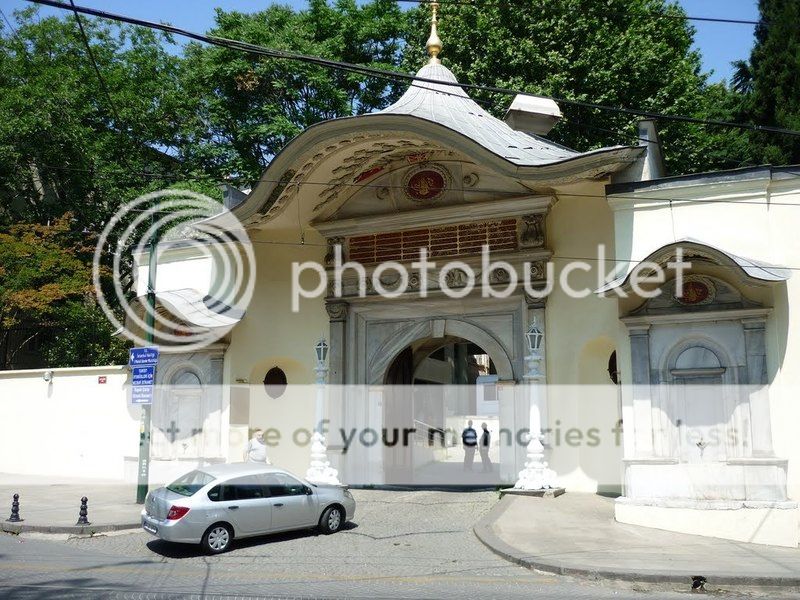
BAB-I ALİ GATE
Gülhane, Fatih - Istanbul - Turkey
GPS : 41°00'40.1"N 28°58'40.8"E / 41.011140, 28.977991
PHOTOGRAPHS ALBUM
The ornamental crown gate in Alemdar Street opening to İstanbul is a synecdoche for the Ottoman Empire, referring to the High Gate of the Divan (court). In the beginning, the structure used to be called ‘Pasha Gate’ or ‘Bâb-ı Âsafi’.
A block beyond the mosque we come to Alemdar Caddesi, the avenue which skirts the outer wall of Topkapı Sarayı. Just to the left at the intersection we see a large ornamental gateway with a projecting roof in the rococo style. This is the famous Sublime Porte, which in former days led to the palace and offices of the Grand Vezir, where from the middle of the seventeenth century onwards most of the business of the Ottoman Empire was transacted.
Hence it came to stand for the Ottoman government itself, and ambassadors were accredited to the Sublime Porte rather than to Turkey, just as to this day ambassadors to England are accredited to the Court of St. James. The present gateway, in which it is hard to discover anything of the sublime, was built about 1843 and now leads to the various buildings of the Vilayet, the government of the Province of Istanbul. The only structure of any interest within the precinct stands in a corner to the right of the gateway.
This is the dershane, or lecture-hall of an ancient medrese; dated 1565, it is a pretty little building in the classical style of that period. The Sublime Porte, also known as the Ottoman Porte or High Porte (Ottoman Turkish: Bâb-ı Âli or Babıali, from Arabic: bāb "gate" and Arabic: alī "high"), is a metonym for the central government of the Ottoman Empire, by reference to the gate giving access to the block of buildings that housed the principal state departments in Istanbul. Today, the buildings house the provincial Governor of Istanbul.
Porte is French for "gate". When Sultan Suleiman the Magnificent sealed an alliance with King Francis I of France in 1536, the French diplomats walked through the monumental gate or Bab-ı Ali in order to reach the Vizierate of Constantinople, seat of the Sultan's government. French being the language of diplomacy, the French translation Sublime Porte (the adjective being unusually placed ahead of the word to emphasise its importance) was soon adopted in most other European languages, including English, to refer not only to the actual gate but as a metaphor for the Ottoman Empire.
"Sublime Porte" was used in the context of diplomacy by Western states, as their diplomats were received at the porte (meaning "gate"). During the second constitutional era of the Empire after 1908 (see Young Turk Revolution), the functions of the classical Divan-ı Hümayun were replaced by the reformed Imperial Government, and "porte" came to refer to the Foreign Ministry. During this period, the office of the Grand Vizier came to refer to the equivalent to that of a Prime Minister, and viziers became members of the Grand Vizier's cabinet as government ministers.
LOCATION SATELLITE MAP
These scripts and photographs are registered under © Copyright 2016, respected writers and photographers from the internet. All Rights Reserved.
GPS : 41°00'40.1"N 28°58'40.8"E / 41.011140, 28.977991

PHOTOGRAPHS ALBUM
The ornamental crown gate in Alemdar Street opening to İstanbul is a synecdoche for the Ottoman Empire, referring to the High Gate of the Divan (court). In the beginning, the structure used to be called ‘Pasha Gate’ or ‘Bâb-ı Âsafi’.
A block beyond the mosque we come to Alemdar Caddesi, the avenue which skirts the outer wall of Topkapı Sarayı. Just to the left at the intersection we see a large ornamental gateway with a projecting roof in the rococo style. This is the famous Sublime Porte, which in former days led to the palace and offices of the Grand Vezir, where from the middle of the seventeenth century onwards most of the business of the Ottoman Empire was transacted.
Hence it came to stand for the Ottoman government itself, and ambassadors were accredited to the Sublime Porte rather than to Turkey, just as to this day ambassadors to England are accredited to the Court of St. James. The present gateway, in which it is hard to discover anything of the sublime, was built about 1843 and now leads to the various buildings of the Vilayet, the government of the Province of Istanbul. The only structure of any interest within the precinct stands in a corner to the right of the gateway.
This is the dershane, or lecture-hall of an ancient medrese; dated 1565, it is a pretty little building in the classical style of that period. The Sublime Porte, also known as the Ottoman Porte or High Porte (Ottoman Turkish: Bâb-ı Âli or Babıali, from Arabic: bāb "gate" and Arabic: alī "high"), is a metonym for the central government of the Ottoman Empire, by reference to the gate giving access to the block of buildings that housed the principal state departments in Istanbul. Today, the buildings house the provincial Governor of Istanbul.
Porte is French for "gate". When Sultan Suleiman the Magnificent sealed an alliance with King Francis I of France in 1536, the French diplomats walked through the monumental gate or Bab-ı Ali in order to reach the Vizierate of Constantinople, seat of the Sultan's government. French being the language of diplomacy, the French translation Sublime Porte (the adjective being unusually placed ahead of the word to emphasise its importance) was soon adopted in most other European languages, including English, to refer not only to the actual gate but as a metaphor for the Ottoman Empire.
"Sublime Porte" was used in the context of diplomacy by Western states, as their diplomats were received at the porte (meaning "gate"). During the second constitutional era of the Empire after 1908 (see Young Turk Revolution), the functions of the classical Divan-ı Hümayun were replaced by the reformed Imperial Government, and "porte" came to refer to the Foreign Ministry. During this period, the office of the Grand Vizier came to refer to the equivalent to that of a Prime Minister, and viziers became members of the Grand Vizier's cabinet as government ministers.
LOCATION SATELLITE MAP
These scripts and photographs are registered under © Copyright 2016, respected writers and photographers from the internet. All Rights Reserved.
Subscribe to:
Comments (Atom)