Showing posts with label egrikapi. Show all posts

Sunday, May 13, 2018

KAZASKER İVAZ EFENDİ MOSQUE

Eğrikapı, Fatih - İstanbul - Turkey

GPS : 41°02'17.1"N 28°56'27.9"E / 41.038083, 28.941083


PHOTOGRAPHS ALBUM

Istanbul, a house of many beauties, is still a big attraction for both domestic and foreign tourists with its various designs of architecture and unique buildings. Not only with its name but also with historical buildings Istanbul makes its mark. And Kazasker Ivaz Efendi Mosque is one of these beauties. Ivaz Ağa Mosque, which is said to have been built by Sinan the Architect in 1585, also can be seen there.

After you leave Edirnekapı and go down following the city-walls along the Golden Horn, you will come across graveyards, woods and finally the Kazasker Ivaz Efendi Mosque, which stands out with its all modestness on the city-walls as if hidden in the greens.

Ivaz Ağa Mosque, which is said to have been built by Sinan the Architect in 1585, also can be seen there. The restoration, made after the fires of 1729 and 1782, can be viewed especially well from the west wall of the mosque. The central space of the mosque which measures 15.6 x 14.5 m is roofed by a dome 9.8 m in diameter and 16.6 m in height.

The interior is very elegant and gives a great sense of light, illuminated as it is by many windows in all its walls. The west façade is most unusual: instead of a central entrance-portal there are double doors at each end of the façade, the rest of it being filled with windows; the effect is very pretty. Another odd, indeed unique, feature is that the minaret is at the south-east corner. Originally there was a porch, evidently with a sloping roof supported by columns, which ran round three sides of the building.

The mosque is almost square, its dome resting on four semidomes with stalactite cornices; the mihrab is in a projecting apse and is decorated with Iznik tiles of the best period. The centre of the west wall is occupied by a gallery in two stories supported on slender marble columns. There are also wooden galleries to north and south, but these are probably not original - certainly not in their present form.

There are two doors at the front facade and one door at both the east and west facades. The interior of the mosque is embellished with 16th century İznik ceramics, which are spectacular. The ruins of Isaac Angelus Tower belonging to Blachernae Palace, where the mosque was built upon, can be seen.

It is the only monumental building right next to the Anemas Dungeons in Ayvansaray and single-domed work of architect Sinan. The wooden portico it used to have in the past does not exist today. Well, a work of Sinan as we mentioned before, and finding many characteristic features is possible here.

Generally these kinds of mosques have a door on the centerline. In Kazasker Ivaz Efendi Mosque however, there are same-sized double doors on the left and right of the entrance frontal. The interior doors open to the place where women perform prayer (namaz), and the outer ones open to the essential place for performing prayer (namaz).

This mosque in Edirnekapı has been surviving for about 600 years, built in 1585 by architect Sinan. The Mosque, built on the command of Kazasker Ivaz Efendi, is a significant memento from our ancestors, surviving with the same name.

This mosque is an architectural structure which tells us about the splendid times of its era, which highlights the equality of women and men. Throughout the history it has been used with different purposes. Sometimes it served as a madrasah and sometimes as a school. One of the important features of this unique mosque is the mihrab decorated with Iznik Ceramics.

The colorful and patterned ceramic decorations raised the attraction. Kazasker Ivaz Efendi Mosque stands as one of the most beautiful samples of its time with both its ceramics and architectural features. Today, however, it goes on living with curious looks upon it. The mosque, which is located in a narrow area, is a popular place today for tourists and photographers.

There is a small square on the walkway in front of the Ayazma (the holy spring) on Dervişzade Street in Eğrikapı and the fountain of architect Mustafa Ağa dated from the 18th century is standing in the middle of this square.

LOCATION SATELLITE MAP


These scripts and photographs are registered under © Copyright 2018, respected writers and photographers from the internet. All Rights Reserved.

Tuesday, March 21, 2017

CEMALİZADE (CEMALEDDİN UŞŞAKİ) TEKKESİ

Eğrikapı, Eyüp - İstanbul - Turkey

GPS : 41°02'08.7"N 28°56'18.0"E / 41.035750, 28.938333

 photo cemalizade_lodge105.jpg

PHOTOGRAPHS ALBUM

This lodge is located in the Defterdar neighbourhood, just outside Eğrikapı and directly opposite the Eğrikapı Cistern, which is connected to the Kırkçeşme water network. It was builtas a masjid-lodge at the end of the 16th century by Vezir Hirami Ahmed Paşa (died 1599). Sheik Seyyid Mehmed Cemaleddin of Edirne (died 1751), who founded the Uşşakiye branch, known as “Cemaliyye-i Saniye,” of the Halvetiyye sect, was the head of the religious order here from 1742.

When he was buried here after his death, it became known as the main lodge and home of the founder of the Cemaliyye-i Saniye. The lodge remained in the possession of the descendents of Cemaleddin Uşşaki, known as "Cemalizade", until 1835. From 1835-1837 it was acquired by the Sünbüliyye branch of the Halvetiyye order and from 1837 onwards by the şalcızade family, who were members of the Haliliyye (Geredeviyye) sub-branch of the şabaniyye branch of the same sect.

The major changes made to the lodge after 1742 include the addition of a pulpit to the masjid-ceremonial hall and the construction of a nearby school by the bond treasurer Sabih Ali Efendi (died 1769), the replacement of the wooden minaret with a brick on by the sword bearer of the Grand Vezir, Seyyid Mehmed Paşa (died 1788), the repair of the tomb by Halet Said Efendi (died 1823) in 1816-17 (1232), the restoration of the lodge by Sultan Abdülhamid II in 1887-88 (1305) and of the tomb by Hamdi Bey, who was in the service of the same sultan, in 1905-06 (1323).

The rectangular masjid-ceremonial hall with its alternately patterned wall and adjacent tomb, gathered together under a single roof, is an unpretentious example of late Ottoman architecture that has survived to our day. The masjid-ceremonial hall is no different from any other late-period mosque, with its closed porch, northern-facing entrance, ordered rows of round-arched windows on the east and west walls, male galleries to the north and grilled women’s galleries above the porch.

The cut sandstone pedestal and diamond patterned base section of the cylindrical minaret have survived from the original. The windows of the tomb, which holds a total of six wooden sarcophagi belonging to Pir Cemaleddin Uşşaki and the Cemalizade, are in the neo classical (empire) style of the era of Sultan Mahmud II (1808-1839), when this section was restored it was crowned with basket handle arches, and a separate entrance was designed to the east.

On the southern façade facing Eğrikapı are two inscriptions in verse, the lower documenting renovations carried out in 1232 (1816-17) and the upper one those carried out in 1323 (1905-06). The first was composed and executed by Yesarizade Mustafa İzzet Efendi (died 1849), while the verse of the second was composed by Ahmed Bahai Efendi (died 1923) and the calligraphy executed by Mehmed Hulusi Efendi (died 1940).

The only aspect of the design of the Cemalizade Lodge that is worthy of attention is the lack of a wall dividing the masjid-ceremonial hall and the tomb, thus fusing the two areas. The raised floor of the tomb and its facing in the direction of the Mecca render this fusion more meaningful. After the closure of the lodges, this building began to be used as a mosque only, and a short time before 1958 it underwent a restoration in which a wall was built between the two sections, thus depriving the building of its most striking feature.

The other sections of the lodge were consigned to history during the Republican era, and in recent years the façades of the tomb have been covered with the most hideous tiles. As for Group III, this consists of religious buildings of mixed design, whose inner divisions are as close to civil architecture as their outer appearance. Since the earliest sufi buildings in Islamic history evolved from the houses of their sheiks, these examples could be called "house-tekkes", and must be regarded as perpetuating the oldest tradition from among their peers in Eyüp Sultan.

In examples from this group, the sections relating to worship and visiting (ceremonial hall / semahane and tomb), housing, education and eating (meeting room, harem, dervish cells, kitchen, refectory etc) were all or partially contained within the same block, with quite complicated connections being established between these sections according to the functions dictated by the life and formalities of the lodge.

In most of these buildings the fusion of the ceremonial hall and tomb that was discussed above can be observed. The design of these establishments most clearly reflect the unity of the worship-visiting-education-housing-eating spaces that distinguishes sufi buildings from other religious structure, and their plans, façades and details display great proximity to the traditions of Istanbul’s civil architecture.

LOCATION SATELLITE MAP


These scripts and photographs are registered under © Copyright 2017, respected writers and photographers from the internet. All Rights Reserved.

Friday, March 10, 2017

PORPHYROGENITUS PALACE

Eğrikapı, Fatih - Istanbul - Turkey

GPS : 41°02'02.0"N 28°56'25.0"E / 41.033889, 28.940278
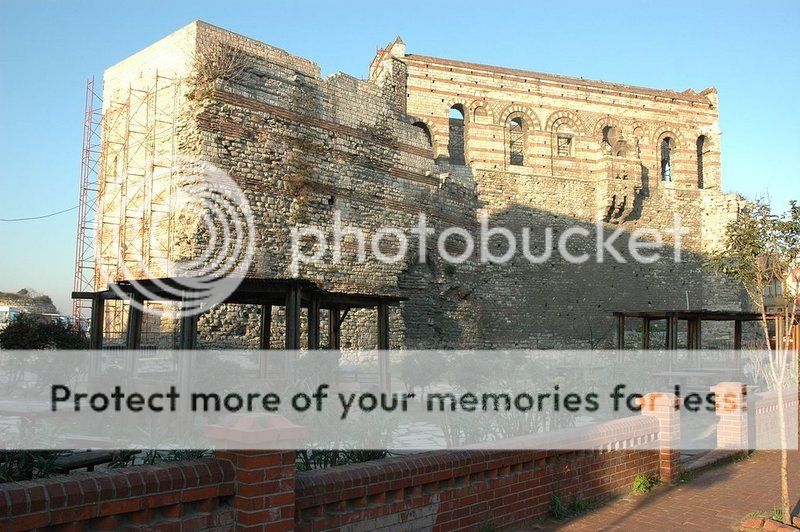
Tekfur Palace / Egrikapi - Istanbul photo tekfur_palace101.jpg

PHOTOGRAPHS ALBUM

Tekfur Palace, which is located between Edirnekapı and Eğrikapı beside the ramparts is known to be the only palace surviving from Byzantine period to date. According to the researches, it was determined that the palace belonged to the 13th century. Tekfur Palace is the only sample that remained from the Byzantine Period. Tekfur Palace has an important place not for only Istanbul but also for the world art history since it reflects Byzantine civil architectural style. The date when the palace was built and by whom it was built is still not certain.

The Palace of the Porphyrogenitus, also known as the Palace of Constantine Porphyrogenitus (Turkish: Tekfur Sarayı) which means "Palace of the Emperor" is the ruins of a 13th century Byzantine palace in the north-western part of the old city of Constantinople (present-day Istanbul). The Palace was constructed during the late 12th or early 13th centuries as part of the palace complex of Blachernae, where the Theodosian Walls join with the later walls of the suburb of Blachernae.

Although the palace appears at first glance to be named after Constantine VII Porphyrogenitus, the 10th Century emperor, it was built long after his time. It is in fact named after Constantine Palaiologos, a son of the Emperor Michael VIII Palaiologos. Porphyrogenitus, meaning literally "born to the purple", in this context indicates a child who is heir to the Byzantine throne. The palace served as imperial residence during the final years of the Byzantine Empire.

The palace suffered extensive damage due to its proximity to the outer walls during the Ottoman conquest of Constantinople in 1453. Afterwards, it was used for a wide variety of purposes. During the 16th and 17th century, it housed part of the Sultan's menagerie. The animals were moved elsewhere by the end of the 17th century, and the building was used as a brothel. From 1719, the Tekfur Sarayı pottery workshop was constructed, and began to produce ceramic tiles in a style similar to that of İznik tiles, but influenced by European designs and colors.

The studio had five kilns and also produced vessels and dishes. The project lasted for around a century before going out of business, and by the first half of the 19th century, the building became a poorhouse for Istanbul Jews. In the early 20th century, it was briefly used as a bottle factory, before being abandoned. As a result, only the elaborate brick and stone outer façade survives today, but it is the only major surviving example of secular Byzantine architecture. As of 2006, the palace was undergoing extensive restoration.

The Blakhernai Palaces, known today as Tekfur Palace, was built by the Byzantines in the 12th century and used as an imperial residence until the Conquest of Constantinople in the 15th century. The palace complex was built next to the city walls at the ancient Blakherna district, in todays Eğrikapı neighborhood near Kariye (old church of St. Savior in Chora). The area was one of the seven hills of the old city. The cellars of the palace, known as Anemas Dungeons, were also built next to the walls a little bit further north, just near Ivaz Efendi Mosque.

During the Byzantine period, Tekfur palace was also known as Constantine Porphyrogenetus Palace. It was a pavilion of the Blakhernai Palace complex. The pavilion had three floors with a wooden roof and wooden floors, and was used by the emperor during his visits to the Theotokos church where the mantle of Virgin Mary was kept. The pavilion was enlarged during the reign of Manuel Komnenos I in the 12th century and became a summer residence for the Byzantine emperors.

The Palace was a large three-story building located between the inner and outer fortifications of the northern corner of the Theodosian Walls. The ground floor is an arcade with four arches, which opens into a courtyard overlooked by five large windows on the first floor. The top floor of the structure project above the walls, and has windows on all four sides. On the east is the remnant of a balcony. The roof and all of the floors of the structure have disappeared.

The remaining walls are elaborately decorated in geometric designs using red brick and white marble typical of the late Byzantine period. The Palace reaches to this day from Edirnekapı as concealment with its lives hidden in the pages of history and still adored architecture. Lying between the Theodosios walls in Balat with the load of the centuries, the four walls remained Tekfur Palace watches a large landscape stretching from Pera to Yedikule and from the Prince Islands to Kadıköy.

It is not known, since there is no epigraph on it, who built the Tekfur Palace which is a part of Blahernai Palace Complex one of the Byzantine Era structures - the other one is the Bukoleon Palace - and it is not known what the original name of it was. Tekfur Palace, which is important for world art history since it represents the first civilian architecture style of the Byzantine, is a part of the Blahernai Palace Complex where the Byzantine Emperors settled after leaving the palace in Sultanahmet in the 11th century.

As in Ottoman palaces, Byzantine palaces were comprised of many manor houses. Tekfur palace too, was one of the manor houses belonging to the Blahernai Palace Complex. According to the information we obtained from the Hayri Fehmi Yılmaz, an art historian and the coordinator of Foundation for Developing Cultural Consciousness, the middle floor of the three storey palace was reserved to the palace dwellers. This floor had a beautiful panorama of the city. Ground and top floors were used for services.

The frontage of the palace built in the 14th century opens to a small courtyard. Tekfur Palace which was built as a two building structure has another manor house in its courtyard. Also there is a chapel on the city-side front of the structure. Although it is partially collapsed, this chapel, which we can describe as a ‘private devotion room’, is extant to today. Hayri Fehmi Yılmaz defines this chapel where all the religious motifs and elements in a church can be found, as a ‘one-man devotion cell’.

Yılmaz, who says that ‘for the Blahernai Palace Complex which spans a 100-180 thousand square meters area, one should dream of a huge palace’, denotes that this palace complex was composed of large gardens, terraces, churches and manor houses. Located in a strategically interesting position, the palace looks at the city with its one side and the outskirts of the city with its other side. That is to say, it gives the opportunity to escape to the city or out of the city when necessary. Besides it is thought that the Byzantine Emperors preferred Blahernai palace for this reason.

The wall tiles produced at the Tekfur Palace, which was used as a tile workshop in the 18th century, still bedeck many mosques. These works of art called ‘Tekfur çinileri (Tekfur tiles)’ were produced by the adepts brought from İznik (Nicea). After the conquest of İstanbul, the palace getting popular for a short time with its adepts from İznik, later it was used as glass furnace and later on, in the 19th century, as a refuge for the Jews, and at last in 1865, it became uninhabitable after a fire that caused collapsing of the intermediate floors.

To understand the once grandeur of the Tekfur Palace, except for the tiles, it is also possible to mention the pots decorating the frontage of the palace. These pots made of red bricks and white stones, are of the most beautiful examples where two different materials are used together. This decorative art, mostly seen in Bulgaria and Balkan Peninsula, is seen only in Tekfur Palace and the belfry of the Saint Benoit French Lycée.

It is not so difficult to dream about the brilliant days of Tekfur Palace which is now a ruin. The overhangs sitting on the consoles on the frontages which we can see in late Ottoman architecture draws attention immediately. Today, this unequalled building virtually challenges time.

Tekfur Palace which is under the auspices of Fatih Municipality, still exists as a three storey, roofless building. The seventeen meters long basement, which opens to the front courtyard with four large arcs, is divided into twelve sections each covered with high vaults. The double columns carrying the arcs opening to the courtyard and their capitals were reproduced in the last restoration. There are niche-like cabinets with stone shelves at two sides of the windows in the large arcs on the second floor wall facing the courtyard and on the four walls of the third floor.

Just beyond the site of this gate there stands one of the most remarkable buildings remaining from the days of Byzantium. It is known in Turkish as Tekfur Saray, or the Palace of the Sovereign, though it is sometimes called the Palace of the Porphyrogenitus. The palace was probably built in the latter part of the thirteenth or early in the fourteenth century, and served as one of the imperial residences during the last two centuries of the Empire: it was perhaps an annexe of the nearby Palace of Blachernae.

It is a large three-storeyed building wedged in between the inner and outer walls of the last stretch of the Theodosian fortifications. On the ground floor an arcade with four wide arches opens onto the courtyard, which is overlooked on the first floor by five large windows. The top floor, which projects above the walls, has windows on all sides, seven overlooking the courtyard, a curious bow-like apse on the opposite side, and a window with the remains of a balcony to the east.

The roof and all the floors have disappeared. The whole palace, but especially the façade on the court, is elaborately decorated with geometrical designs in red brick and white marble so typical of the later period of Byzantine architecture; compare the façades of St. Saviour in Chora and of St. Theodore, both of the fourteenth century. After the Conquest the palace was used for a variety of purposes. During the sixteenth and seventeenth centuries it was used as a menagerie, particularly for larger and tamer animals such as elephants and giraffes.

The latter animal particularly amazed European travellers, for they had never seen one before. In 1597, Fynes Moryson describes it thus: “a beaste newly brought out of Affricke, (the Mother of Monsters) which beaste is altogether unknowne in our parts, he many times put his nose in my necke, when I thought my selfe furthest distant from him, which familiarity I liked not; and howsoever his Keepers assured me he would not hurt me, yet I avoided those his familiar kisses as much as I could.”

Before the end of the seventeenth century the animals were moved elsewhere and the palace served for a while as a brothel. But it was soon redeemed from this misuse; for in 1719 there was set up here the famous Tekfur Saray pottery. This works produced a new kind of Turkish tile, the so-called Tekfur Saray type, inferior indeed to those of Iznik and beginning to show European influence, but nevertheless quite charming. The project, however, was short-lived and by the second half of the eighteenth century the palace was in full decline and finally lost its roof and floors.

During the first half of the nineteenth century Tekfur Saray served as a poorhouse for the indigent Jews of Stamboul. About 1860, the American missionary Cyrus Hamlin, searching for a site for the future Robert College, seriously considered purchasing the palace and restoring it for use as an educational institution; perhaps fortunately, the idea was abandoned in favour of the present site of the College (now Boğaziçi University) on the Bosphorus.

In recent years the palace has served as a bottle works and storehouse - the lamentable history of a palace down on its luck. The building is now a mere shell; but in recent years the surviving structure has been well restored. Just beyond Tekfur Saray the Theodosian wall comes to an abrupt end, and from there the fortifications are continued by walls of later construction. There has been much discussion about the original course of the Theodosian walls from Tekfur Saray down to the Golden Horn.

It would appear that they turned almost due north at Tekfur Saray and from there followed a more or less straight line down to the Horn, whereas the present walls are bent in an arc farther out into Thrace. Stretches of what are undoubtedly the original Theodosian wall can be seen at Tekfur Saray and also along Mumhane Caddesi, which we reach by turning right in the little square beyond the palace and then taking the first left. The ruined walls along this street are quite impressive and picturesque.

The present stretch of walls from Tekfur Saray to the Golden Horn is quite different from the Theodosian fortifications. It is a single bulwark without a moat; to make up for this deficiency it is thicker and more massive than the main Theodosian wall and its towers are stronger, higher and closer together. The part of the wall that encloses the western bulge between Tekfur Saray and the Blachernae terrace can be fairly well inspected if we follow the street closest to the wall and walk through the gardens of the intervening houses.

Tekfur Palace is cared for by the Fatih Municipality, and still exists as a three-storey, roofless building. The 17-meter-long basement, which opens to the front courtyard with four large arches, is divided into twelve sections each covered with high vaults. The double columns carrying the arches open onto the courtyard and their capitals were reproduced for the last restoration. There are niche-like cabinets with stone shelves at two sides of the windows in the large arches on the second floor wall facing the courtyard and on the four walls of the third floor.

It was used for various aims after the conquest of Istanbul in 1453. It was restored between the years 1955 - 1970. Presently Tekfur Palace is a three storey building without a roof. Today, one can see the façade of the Tekfur palace and the remains of four walls. It has a rectangular plan. Outer walls, arches and window frames of the palace are decorated with stones and bricks. I

f you follow the walls to the direction of the Golden Horn, you can reach to the Anemas Dungeons as well. At the moment these tunnels and halls are being cleaned so it's not open to the public, it can be visited only by a special permission. As of March 2015, the building now has roof and glass windows.

LOCATION SATELLITE MAP


These scripts and photographs are registered under © Copyright 2017, respected writers and photographers from the internet. All Rights Reserved.

Wednesday, March 1, 2017

BLACHERNAI PALACE

Eğrikapı, Fatih - Istanbul - Turkey

GPS : 41°02'02.0"N 28°56'25.0"E / 41.033889, 28.940278

Blachernai Palace / Egrikapi - Istanbul photo blachernae_palace101.jpg

PHOTOGRAPHS ALBUM

The Blachernai Palaces, was built  in the 12th century and used as an imperial residence until the conquest of the city. The palace complex was built next to the city walls at Egrikapi. The area was one of the seven hills of Constantinople. During the Byzantine period, The Tekfur Palace was also known as Constantine Porphyrogenetus Palace. It was a pavilion of the Blakhernai Palace complex. The pavilion had three floors with a wooden roof and wooden floors. During the reign of Manuel Komnenos I it became a summer residence.

After the conquest of the city until today, it was named as Tekfur palace and was used as a storage, stable, bottle blowing factory, ceramics atelier. Today, one can see the facade of the  palace and the remains of four walls. It has a rectangular plan. Outer walls, arches and window frames of the palace are decorated with stones and bricks. It's not open to the public today.

As the Bucolean Palace was destroyed after the occupation by the Latins, the dynasty moved to the Blachernae Palace. Therefore, it was the residence of the last Byzantian emperors. Large ceremonies, such as placing the crown on the emperor’s head and sitting down on the throne were held in this palace. Until today, the Blachernai Palace has remained the most solid palace / the palace that has remained intact the most.

The Palace of Blachernae was an imperial Byzantine residence in the suburb of Blachernae, located in the northwestern section of Constantinople (modern Istanbul, Turkey). The area of the palace is now mostly overbuilt, and only literary sources are available as to its description. The Palace of Blachernae was constructed on the northern slopes of the Sixth Hill of the city in circa 500. The hill itself was partially remodelled, particularly in later times, and a number of terraces created to support the various buildings comprising the palace complex.

Although the main imperial residence during the 4th-11th centuries was the Great Palace at the eastern end of the city, the Blachernae palace was used at times, and is attested in the ceremonial protocols contained in the 10th-century De Ceremoniis, or Explanation of the Order of the Palace, Chapters I.27, I.34, II.9, II.12) of Emperor Constantine VII Porphyrogennetos (r. 945-959). At that time, it included several structures: the hall (triklinos) of Anastasius or Anastasiakos, named after Emperor Anastasius I (r. 491-518) who built it, the hall of the Ocean or Okeanos, the portico of Joseph or Iosephiakos, and the hall of the Danube or Danoubios.

The latter communicated with the nearby shrine of the Greek Orthodox Church of St. Mary of Blachernae through a series of staircases. It was here that in the late 11th century the Emperor Alexios I Komnenos (r. 1081-1118) moved his main residence, and he and his grandson Manuel I Komnenos (r. 1143-1180) undertook great works there, fortifying the palace precinct and erecting new halls. Manuel I, in particular, is credited with the construction of an elaborate outer wall, and of several splendid new halls, such as the Hall of Irene (named after Empress Irene of Hungary) and the Polytimos Oikos ("Valuable House").

At this time the palace complex became known as the "New Palace". Among the structures of the time, only the so-called Prison of Anemas, which formed part of the palace's substructure, still survives. After the Fourth Crusade, the Latin emperors favoured the Bucoleon Palace, but on the recapture of the city in 1261, the Palaiologan emperors restored the Blachernae complex as their principal residence.

The Palace of the Porphyrogenitus, probably dating to the late 13th century, although a bit further south than the main Blachernae palace complex, is usually related to it. It is the only relatively intact example of Byzantine palace architecture in Constantinople.

Blachernae was a suburb in the northwestern section of Constantinople, the capital city of the Byzantine Empire. It is the site of a water source and a number of prominent churches were built there, most notably the great Church of St. Mary of Blachernae (Panagia Blacherniotissa), built by Empress Pulcheria in c. 450, expanded by Emperor Leo I (r. 457-474) and renovated by Emperor Justinian I (r. 527-565) in the 6th century.

The quarter is recorded as regio XIV in the early 5th-century Notitia Urbis Constantinopolitanae, where it is recorded as being enclosed by a wall of its own. The quarter was connected to the city proper at the construction of the Theodosian Walls, but the Church of St. Mary remained outside of the walls until 627, when Emperor Heraclius (r. 610-641) built another wall to enclose it. By that time, the church had become the major Marian shrine of the city, and the second-most important church in Constantinople after Hagia Sophia, if only because the emperors' residence was nearby.

In 1347, Emperor John VI Kantakouzenos (r. 1347-1354) was crowned there, instead of at Hagia Sophia. South of the church and situated on the city's Seventh Hill stood the imperial Palace of Blachernae, which was first erected in c. 500. During the Komnenian period, it became the favourite imperial residence, eclipsing the older Great Palace of Constantinople on the eastern end of the city.

Although the Latin emperors returned to the Bucoleon Palace, the Palaiologos emperors of the restored Byzantine Empire again used the Blachernae Palace as their main residence. The Palace of the Porphyrogenitus (Turkish: Tekfur Sarayı) and the so-called Prison of Anemas are the main surviving structures of the Palace of Blachernae, which was a complex of multiple buildings.

Following the fall of Constantinople to the Ottomans in May 1453, the Sultan's residence was moved to Topkapı Palace on the site of the ancient acropolis of Byzantium, opposite to the original site of the Great Palace, which had by this time fallen into complete ruin, and the Blachernae area (with the exception of the Palace of Porphyrogenitus) fell into disuse.

The historic Blachernae area is in the present-day Istanbul quarter known as Ayvansaray. The sacred spring, associated with the Virgin Mary, can still be visited today; in Turkish it is named Ayazma, a name derived from the Greek term hagiasma, meaning "holy water".

LOCATION SATELLITE MAP


These scripts and photographs are registered under © Copyright 2017, respected writers and photographers from the internet. All Rights Reserved.