Cankurtaran, Fatih - Istanbul - Turkey
GPS : 41°00'20.6"N 28°58'50.0"E / 41.005722, 28.980556
 PHOTOGRAPHS ALBUM
It is recorded that in the year 425 of the Common Era era, by decree of the Byzantine emperor Theodosius II, a secular institution of higher learning was established in Istanbul, then known as Costantinopolis. Assembling the various branches of human inquiry under the roof of the so-called Magnaura Palace, this institution can be considered a very early type of university; indeed, in a history of universities, it appears on top of the list as being the oldest university in Europe with names such as University of Costantinopolis, or the Magnaura Palace University or, in Greek, "Pandidakterion tes Magnauras".
The name Magnaura is derived from the Latin phrase Magna Aula meaning a hall capable of containing large number of people, where official ceremonies, meetings are held. In our day, in those Italian universities dating from the Middle Ages, the graduation ceremony still takes place with the presence of "Il Magnifico Rettore" (the magnificent rector), in the prestigious Aula Magna in Italian the two words are placed in reverse order and pronounced as aula manya.
The Aula Magna designed by R. Erskine in 1997 for the Frescati Campus of the Stockholm University, making an honourable contribution to modern architecture, is a stucture which offers glass transparency to the surrounding old trees, its central idea being based on the classical amphiteater; the building is open to all kinds of cultural activities worthy of the University's high standard.
Following the closure in Athens of the Plato Academy in 529, the noble task of preserving the written heritage of the classical cultures was passed on to Costantinopolis, namely our city of Istanbul. In order to transmit this past knowledge to future generations, monks in the monasteries were working hard in the "Scriptorium" (‘writing-area') copying manuscripts under the watchful eye of the "Armarius" (‘head monk').
In the renowned monastery of Studion, close to Yedikule district and to the Marmara sea, for example, a group of monks slept while another group without interval continued copying and multiplying ancient manuscripts (this Monastery was also known as that of "Akoimetoi", i.e. ‘Non-Sleepers'). Scholars are telling us that books copied in the monasteries were generally related or limited to theological matters; whereas books of any kind, whether commissioned by the emperor or by the many urban benefactors (maecenas) were copied by the individual scribes and in workshops. It was thanks to such people curious about ancient lore that the city must have gained a paradise-like atmosphere for books.
The higher learning institute, pride of the Islamic world, Beytü'l-Hikme, established in Baghdat under al-Ma'mun (813-835), took the initiative to send envoys to Costantinopolis to obtain books specifically of Plato and Aristotle, which they planned to translate into the Arabic language. Again, such active interest in the intellectual accumulation of the past must be viewed within the context of valuing it and trying to incorporate it to new life.
The Costantinopolis University at Magnaura was restructured by the regent Bardas during the reign of emperor Michael III (842-867). Classes were offered through 31 chairs: 15 in Latin, 16 in Greek. Here, Platonism and Aristotelism were earnestly studied and discussed, and the two traditions thus constantly kept alive.
The functionining of the University lasted until the 15th century; however, after the Latin invasion in 1204, it appears to have lost its secular character which it had maintained since antiquity, entering gradually under the influence of the Church. In a last ditch of effort Manuel Paleolog (1391-1425) was able to establish an institution of higher learning which gained fame for its schools of grammar and Aristotelian philosophy.
Two eminent persons of culture acted as directors of this "Mouseion" covering many fields of study. One was G. Scholarios, respected Aristotelian, who became the first patriarch after the city was taken by the Turks; the other was G. Argyropoulos, more inclined to get closer to the Catholic Church in Rome. This last scholar, in fact, emigrated to Florence where he taught Aristotelian logic.
No wonder, Aeneas Sylvius Piccolomini, later Pope Pius II - himself a very learned individual - impressed by these " illustrissimi viri bizantini " once exclaimed: "anyone who did not possess Constantinopolitan education, could not consider himself thoroughly cultivated !"
It would be appropriate to remind the reader that at the early stages of organized higher education the 'university' as such was not identified with that term. The use of "universitas", came about first in Bologna where it was written down in the statute of the "Universitas Studiorum Bolognensis", established in 1088 (for this very reason some consider the University of Bologna as the oldest one in Europe). Furthermore, in Medieval Latin "universitas" did not carry a reference to an institution of learning of universal breadth; rather, it had a legal meaning.
Infact, at Bologna groups of students belonging to various fields of study (studium) went after teachers and together with them and other officials, including the rector, formed a larger community which operated in a given place, and, developing programs, according to rules and regulations, offered diplomas and rights to obtain them; such community incorporation of all parties was called "universitas".
The great reception hall at Magnaura kept also in it treasures which marvelled ambassadors, foreign or local visitors. Bishop Liutprand of Cremona visited it in the 10th century and in his description he tells that the huge throne was sided as sentinels by two gilded lions roaring frighteningly with open mouth, and every now and then beating the ground with their tail. Suddenly the throne started rising in the air all by itself. He noticed also, nearby, man made birds singing merrily on the branches of a golden tree.
Such fantastic mechanisms moving by themselves (automata) were seen in some palaces of the Islamic world too, especially those in Baghdad. It is understood from sources that during the reign of the emperor Theophilos (813-842), a lover of magnificence, gifts were exchanged between Byzantium and Baghdad. Could it ever be that this precious tree with birds of artifice singing on its branches was a gift from Baghdad?
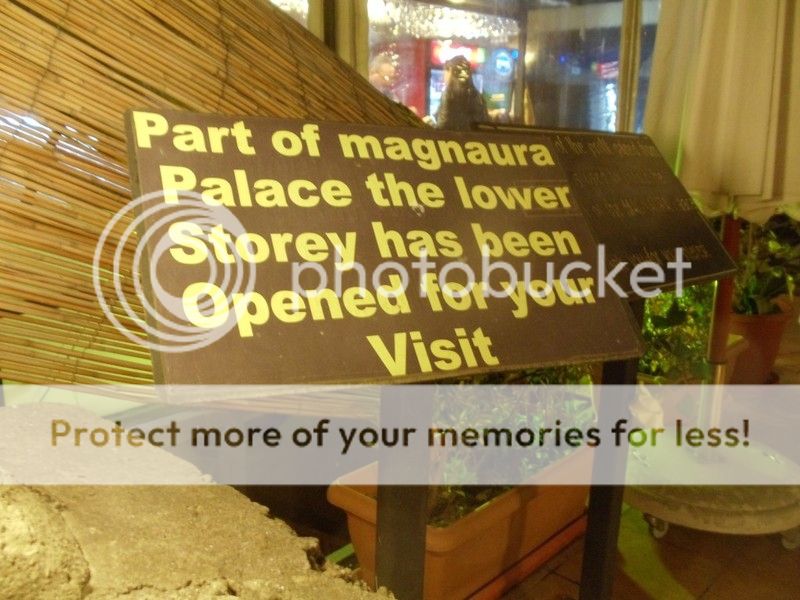
To be blunt, this spot is not for the faint-hearted. Entering the garden behind Nakkaş Halı shop and Palatium café, you will see an area paved with glass, two metal staircases leading down on either side. Follow the staircase on the right: a full 10 meters below ground level, a brick wall holds a small door that opens into mysterious shadows. If you’re feeling nervous, the owner’s sign might not reassure you: “Dear Guests, While you are visiting this facilities our Company is not Responsible from any injury, Accident and Lost Items.” Luckily, our intrepid writer has explored and lived to tell the tale.
Through the doorway, you will find a brick chamber with high arches and beehive-like domes, as well as doors leading into further darkness. The structure’s ragged condition adds to the feeling of a lost civilization, concealed for thousands of years – no one knows what further excavation might uncover. When Fatih Sultan Mehmet took Constantinople in 1453, he is rumored to have quoted the Persian poet Ferdowsi: “The spider spins his web in the Palace of the Caesars.” Magnaura is a reminder that all empires, no matter how glorious, will be covered by the sands of time. Magnaura Palace is close to the Hagia Sophia, right beside the Four Seasons Hotel. Entrance is free, and you can visit any time from 11 am to 1 am.
A cement staircase in the courtyard of Asia Minor Carpet Shop on Kutlugün Street in Sultanahmet, leads down into the subterranean remains of the Senate House of Magnaura Palace. This shop is just one of the hundreds of neighborhood structures built atop the ruins of the Great Palace. In fact, excavations and construction are ongoing around.
ALBURA KATHISMA RESTAURANT KEEPS A SECRET
In the early 1990s, a Greek family refurbished a charming Ottoman home and opened Albura on the cobbled streets of Akbıyık Caddesi. The quality of the cuisine had locals and travelers flocking, making Albura one of the most popular restaurants in Sultanahmet. In 2009, Kathisma, a streetside terrace restaurant next-door, was added.
Today, the Greek family has sold up, but new owners Abuzer and Alp guarantee guests attentive service accompanied by a generous menu overflowing with succulent regional cuisine and tried-and-tested Ottoman favorites. Try the Chef’s specials, the jumbo shrimp in the wok, or the walnut kuzu (lamb with walnuts). For dessert, the traditional Turkish pudding is recommended.
You can choose to dine inside the cozy Ottoman abode or in the elegant streetside terrace, open-air in summer and enclosed in winter. When the belly is full and the plates are cleared, wander to the back of the terrace and find the entrance to one of Istanbul’s best-kept secrets—the well-preserved Byzantine ruins of Magnaura Palace. Take your time to explore this 4th-century basilica-like structure that inspired the design of the Kremlin Palace and San Marco Basilica in Venice.
Back in its heyday, the Palace was decorated in gold and silver, providing a grand setting for Byzantine emperors to welcome dignitaries to Constantinople. Today, it's yours to freely explore and marvel at Istanbul's past.
LOCATION SATELLITE MAP
WEB SITE :
Albura Kathisma Cafè & Restaurant
MORE INFO & CONTACT
E-Mail :
info@alburakathisma.com
Phone : +90 212 517 9031 / +90 212 518 9710
Fax : +90 212 517 9032
These scripts and photographs are registered under © Copyright 2017, respected writers and photographers from the internet. All Rights Reserved.


