Sultanahmet, Fatih - Istanbul - Turkey
GPS : 41°00'31.0"N 28°58'41.0"E / 41.008611, 28.978056
 PHOTOGRAPHS ALBUM
The largest and most magnificent covered cistern in the city is entered through a small building to the west of the Hagia Sophia Square. The ceiling of this forest of columns is made of brick and is cross-vaulted. The name of the cistern comes from a basilica that was once located nearby. According to ancient historians, emperor Constantine had already built a basilica and cistern on the same spot. As the demand for water grew, emperor Justinian enlarged the cisterns and incorporated the basilica.
The Cistern of Philoxenos or Binbirdirek Cistern, is a man-made subterranean reservoir in Istanbul, situated between the Forum of Constantine and the Hippodrome of Constantinople in the Sultanahmet district. It has been restored and is now visited as a tourist attraction.
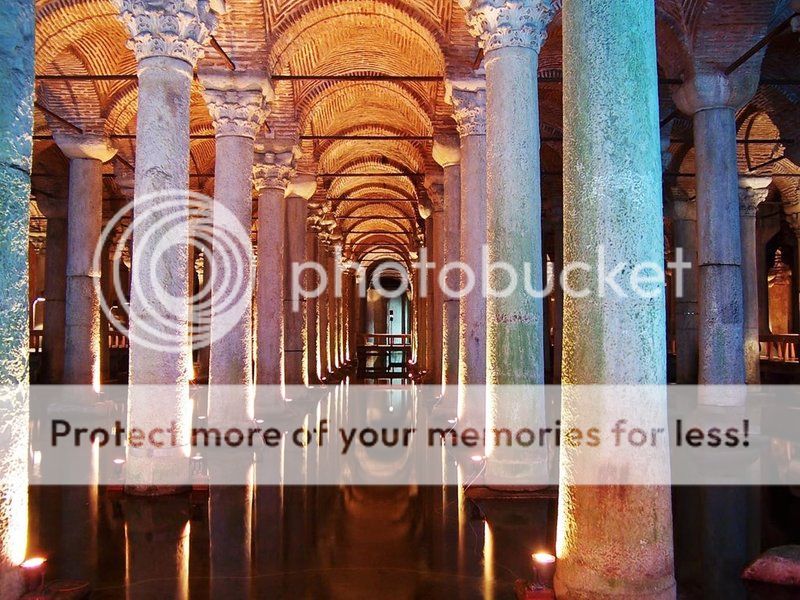
One of the magnificent historical constructions of Istanbul is the Basilica Cistern (Yerebatan), located near south-west of Ayasofya (Hagia Sophia). This huge cistern, which was founded by Justinianus I, a Byzantine Empire (527-565), began to be called by the public "the Sinking Palace" - and not without a reason, seeing the great number of marble columns arising out of the water. In place of the cistern was formerly found a great Basilica, which had probably been built in 3rd or 4th century during the Early Roman Age to be used in commercial and legal affairs and scientific and artistic activities.
The basilica was reconstructed by Ilius after it had burned down in a conflagration that broke out in 476. Then it suffered another conflagration. It had a marble statue during the calamitous Nika rebellion in 532 which terrorized the city. It is narrated in former references that there was a garden here, surrounded by a colonnade, which faced Ayasofya. It is also added that there was a bronze statue of the Prophet Solomon in the garden, with his hand on his chin looking in amazement at Ayasofya, which was even more marvelous than his work. The mentioned statue was later removed by the Emperor Basilius I (867-886).
As is known, the temple that been erected by the Israeli King, the Prophet, Solomon in Jerusalem in his name had been known as the most magnificent work on earth until Ayasofya was constructed. It is further narrated that the Emperor Basilius had the said statue melted and had his statue erected on the spot. The Emperor Justinianus had this cistern built in 542 on the site of the great basilica that had been destroyed in a conflagration.
Again, it is narrated that 7.000 slaves worked in the construction of the cistern. In fact, the cistern borrowed its name from Ilius Basilica in the vicinity. The water of Basilica Cistern came from Eğrikapı Water Distribution Centre in Belgrade Forest, 19 kilometers from the city, through the 971-meter-long Valens (Bozdoğan) Aqueduct, which was built by the Emperor (368) and the 115.45 meter-long Mağlova Aqueduct, which was built by the Emperor Justinianus.
The plan of the Basilica Cistern was drawn by a group of German divers in the early years of this century, according to which it is a giant construction located in a rectangular area with its length of 140 meters and with of 70 meters. Inside this cistern, into which you descend with 52 stone steps, are found 336 columns each 9 meters high and 4.80 meters apart, which are arranged in 12 rows of 28 each. These columns arising out of water remind an endless forest, thus affecting visitors as soon as they entered the cistern. The ceiling weight of the cistern was transferred to the columns by means of cross-shaped vaults and round arches.
The columns the majority of which appear to have been taken from older buildings and which were engraved from diverse types of marble and granite are composed of one piece while some were made up of two pieces that were put one on another. Also, there seem to be different features between the tops of these columns. For instance, while 98 of them reflect Corinth Type, some others reflect Dor Type. The 4.80 meter-thick brick walls of the cistern and the brick floor of the cistern were plastered with a thick layer of Horasan mortar and made water-resistant.
This cistern that was laid on an area of total 9.800 m2 has the capacity to store 100.000 tons of water. The great majority of the columns in the cistern, excluding the few cornered or grooved ones, are in the form of cylinder, among which the one that was embroidered with repeatedly engraved and raised pictures of Hen’s Eye, Slanting Branches and Tears particularly draw attention. As a matter of fact, this column has resemblance to the columns in the Triumphal Arch of Great Theodesius belonging to the IVth century (379-395) erected in the ‘Farum Tauri’ Square during the Byzantine Empire, the remains whereof are now found in today’s Beyazıt Square.
According to a narration, the reason why the figures thereon resemble tears is that it was erected to the memory of hundreds of slaves who died during the construction of the Great Basilica and has ever told their tragedy throughout centuries. The part that goes through the middle section of the cistern and intrudes through the south-west wall as an irregular projection the length whereof is 40 meters and width 30 meters was actually the walls that were built during the restorations in earlier years so that they could bear the weight. As 40 columns remain behind these walls, 9 columns at the longest part and 2 at the narrowest, they are not in vision.
The two Medusa heads used as pedestals at the bottom of the two columns in the north-west corner of the cistern are of the masterpieces of the Roman Period Art of Statuary. Although there is no certain proof as to from which building these heads pertaining to IVth century - which are watched by visitors in great admiration - were taken, it is generally agreed by researchers that they were taken from an antique building pertaining to the Young Roman Age.
Yet, although there seems to be no written evidence explaining that they were used as pedestals of columns, it is again generally certified by researchers that the Medusa heads were used only because they were needed as the pedestals of columns in the construction of the Cistern. If we wish to journey back to the early ages of history about the great number of rumors that were based upon the mythology about Medusa, we could hear narrations like this :
According to a narration, Medusa was one of the three Gorgons, the female dragons of the underground in the Greek Mythology. Of those three sisters only Medusa with snakes for the hair was positive and had the power to turn those that looked at her into stone. Therefore, it is thought that in that period Gorgon-heads, figures and statues were put with an aim to protecting great buildings and special places and Medusa was also placed there with that contemplation.
Still, according to another narration, Medusa was a girl that boasted of her black eyes, long hair and graceful figure, who had long been in love with Perseus, the son of Zeus, a Greek idol. In the meantime, Athene, a female idol, was also in love with Perseus and therefore envied Medusa. For that reason, Athene changed Medusa’s hair into horrible snakes. From then on, whomever Medusa looked at, he was petrified. Later, seeing her in that form Perseus thought in astonishment that Medusa had been bewitched and then he beheaded her.
Thereafter, he took her head in his hand and exposed it to his enemies and petrified them and thus won a lot of wars. It is thus rumored that after that event Medusa’s head was engraved - either upside down or in an oblique position - in the handles of swords and on the pedestals of columns in ancient Byzantium. Yet, according to another rumor, because of her ability to petrify those that looked at her, Medusa saw herself, sometimes in Perseus’s sword and sometimes in the mirror, and thus changed herself into stone.
Accordingly, the sculptor who made the statue here carved Medusa in three different positions by the reflection positions of light: 1) The normal one, which is now in Didim; 2) The statue which is upside down; 3) The oblique one that is now here was brought from Didim. The two gigantic Medusa heads, which are of the masterpieces of the Roman Period Statuary, go on attracting the great attention of people with their positions - upside down or oblique - the water in the Basilica Cistern has been dropping harmoniously ever since and murmuring the song of Medusa to the visitors who promenade in the dim arcane atmosphere of the cistern.
The Underground Cistern, which covered a large area during the Byzantine Empire and provided water to the great palace, where the emperors lived, and the vicinity, was used for a further while after the conquest of Istanbul by the Ottomans in 1453 and the gardens of Topkapı Palace were irrigated with the water from the cistern. It is understood that the Ottomans, who preferred running water to still water, did not use the cistern after they had established their own water facilities. The cistern remained unknown to the West until mid-XVI. century. Then the cistern was discovered by P. Gyllius, a Dutch traveler, who visited Istanbul in 1544-1550 with a view to studying the remains of the Byzantine, and introduced to the west by him.
In one of his researches, when - while he was walking around Ayasofya - P. Gyllius was told that the homefolk of the houses in the vicinity drew water from the large round well-like holes found in their basements with the buckets they dropped down and that they even caught fish, he managed to go down into the cistern armed with a torch through the stone steps in the garden of a wooden house, which was surrounded with walls, which was found upon a large underground cistern.
Under very difficult conditions, P. Gyllius managed to sail around in the cistern and measured it and witnessed the columns. P. Gyllius, who wrote his discoveries and knowledge in his published travelogue, impressed a great number of travelers. Thereupon, all the travelers that visited Istanbul throughout centuries could not afford not to see this magnificent work.
Yet, another author who studied the Basilica Cistern is G. İnciciyan, a historian-researcher. He writes on the Underground Cistern - while he describes the situation of Istanbul in XVIII. Century - in his work entitled ‘History of Istanbul' as follows: “This cistern, which is located south-west of Ayasofya (Hagia Sophia), half a mile away, among houses, was built by Great Constantius under the Great Palace. It bore the name Basilika Kinotexna.
Particularly in winter there were fish in the cistern that was filled like a sea. In fact, it is thought that water came there from the Brook Alibeyköy by means of underground canals. “Here, in saying that the Basilica Cistern was built by Great Constantius (324-337), P. İnciciyan has been mistaken like many researchers and historians...”
Edmando De Amicis, an Italian author, who visited Istanbul towards the end of XIX. century (1874), describes in his work entitled Constantinapolis (Istanbul), wherein he gives his readers rich information on the social life and historical works of the city, by the beauty whereof was enchanted, the arcane atmosphere of the Basilica Cistern in a poetic language as follows: “I entered the garden of a Muslim’s house, descended to the end of dark, humid steps and found myself under the domes of the Great Basilica Cistern of the Byzantium, which was unknown by the Istanbulers how it ended.
The greenish water that is partly enlightened by washing-blue light - which further increases the horror of the darkness - vanishes under the dark domes while the walls shine with the water running down thereon thus dimly discovering the endless rows of columns everywhere like the trunks of trees in a pruned forest.” Ever since its foundation, the Basilica Cistern has undergone several reparations and restorations. The first restoration of the cistern, which was restored twice during the Ottoman State, was fulfilled in 18th century during the reign of Ahmed III (1723) by the Architect Muhammad Ağa of Kayseri.
The second big reparation was realized in 19th century during the reign of Sultan Abdülhamid II (1876-1909). As the eight columns situated in front of the northeast wall of the Cistern towards the middle of the Cistern suffered the risk of breakage during a construction in 1955-1960, each of these was put inside a thick concrete layer, thus losing their former features. The Basilica Cistern has undergone several reparations and restorations ever since its foundation.
The Basilica Cistern, about which such many stories have ever been told, was changed into a museum and opened to visitors by the Istanbul Municipality after the reparations and restorations it has undergone during the Republican Age. Before the cistern has been restored into its present condition, with the works started in 1985 50.000 tons of mud was taken out and a promenade platform was built. This restoration work was completed in 1987 and the cistern was re-opened to visits.
In May 1994, the Basilica Cistern underwent a further great cleaning and maintenance and thus it began to continue its adventure with fish therein as it did in the past. While visitors to the Cistern observe the fish swim among the columns on the one hand, they sip their coffee in the company of the classical music played continuously on the other, thus dive into an arcane journey into the depths of history.
The cistern is surrounded by a firebrick wall with a thickness of 4 meters and coated with a special mortar for waterproofing. The cistern's water was provided from the Belgrade Woods - which lie 19 km north of the city - via aqueducts built by the emperor Justinian. The water level in the cistern changed from season to season. The water was distributed through the pipes at different levels in the eastern wall.
The cracks and the columns were repaired in 1968. Having been restored in 1985 by the Istanbul Metropolitan Museum, the cistern was once again opened to the public on 9 September, 1987. The ground was cleared during the major restoration in 1987, and when over one meter of mud was removed, the original brick pavement and two marble Medusa heads at the base of two of the columns were revealed. The walkway that was constructed at that time enables visitors to walk around the cistern.
LOCATION SATELLITE MAP
WEB SITE :
Basilica Cistern
MORE INFO & CONTACT
E-Mail :
info@yerebatan.com
Phone : +90 212 512 1570 / +90 212 522 1259
Fax : +90 212 522 8166
These scripts and photographs are registered under © Copyright 2017, respected writers and photographers from the internet. All Rights Reserved.


